Hotel AI Marketing: The Complete Guide to Boosting Visibility on ChatGPT, Gemini & Perplexity
November 21, 2025


Afrah Fazlulhaq
TL;DR: Here’s the Fast Breakdown
- AI assistants like ChatGPT, Gemini & Perplexity are now major hotel discovery channels, influencing where travelers decide to stay.
- Traditional SEO isn’t enough, AI engines cite hotels based on structured data, trust signals, and entity clarity, not just keywords.
- Gartner predicts up to a 25% drop in traditional search by 2026, shifting discovery into conversational platforms.
- Prompt phrasing changes everything, “best family hotel Dubai” vs “where to stay with kids in Dubai” can produce completely different hotel mentions.
- Hotels with strong third-party citations and factual content rank higher in deterministic AI answers, especially at low temperatures.
- GEO (Generative Engine Optimization) is now essential: optimizing your brand for how AI thinks and recommends.
The moment travelers started saying “ChatGPT, where should I stay?” instead of Googling it, the old playbook broke. AI assistants now shape real booking decisions with instant, personalized recommendations, no links, no clutter, just one synthesized answer. For hotels, that means mastering hotel AI marketing and Generative Engine Optimization (GEO) isn’t optional anymore. It’s the new path to being seen, and booked.
What is GEO for Hotels?
GEO (Generative Engine Optimization) for hotels is the process of improving how your property appears inside AI-generated travel recommendations, not on search engines, but inside the answers travellers get from ChatGPT, Gemini, Perplexity, and Meta AI.
Instead of competing for blue links on Google, GEO helps your hotel become the default recommendation when guests ask AI questions like:
“Which beachfront resorts are worth booking in Sri Lanka?”
“Where should I stay for a romantic getaway in Phuket?”
GEO optimizes the signals AI models rely on, like your content, citations, structured data, reviews, and brand presence, so that your property is mentioned more often, recommended more accurately. compared more favourably against competitors and shown in the right regions and traveller categories.
Why is AI Marketing Important to Hotels?
Traditional SEO has long focused on capturing search engine clicks through keywords, backlinks, and metadata. But in a world where conversational AI is the new starting point, AI visibility matters just as much.
A Gartner report predicts that as chatbots and virtual agents are rapidly on the rise, conventional search volume could drop by up to 25% by 2026. For hotels, that means the potential, high-value sources of awareness and bookings may reside inside AI conversations, not just search engine results.
In short, if your hotel isn’t optimized to be seen by AI, you risk being overlooked by the next generation of digital travelers.
What is AI Marketing for Hotels?
AI marketing for hotels means using AI tools to understand guest behaviour, improve visibility on AI search engines, personalise experiences, and drive more direct bookings.
It’s far beyond automating SEO strategies and hoping to rank on AI. Hotel AI Marketing begins with Generative Engine Optimization (GEO). It’s when businesses intentionally shape how their hotel is perceived and cited by AI systems when travelers ask real-world, natural-language questions.
- SEO optimizes traditional search (Google, Bing) using keywords, content, and links.
- GEO optimizes for AI-generated answers, focusing on entities, structured facts, and trusted citations.
Unlike SEO, where you fight for page-one clicks, in GEO you aim to be part of the AI’s synthesized answer. That’s where brand credibility meets discoverability.
Why Hotels in APAC and MENA Need AI Marketing?
A 2025 study names certain countries in Asia, the Middle East and Egypt, the most-valued emerging markets for tourism, leading the numbers by 2029.
But what really presses the urgency for AI adoption in Marketing for Hotels?
- AI Is Already a Discovery Channel: According to a study from Amadeus, 64% of global travelers would pay for an AI assistant that could provide in-trip information. For hotels, that means AI could generate the first brand exposure rather than Google.
- Trust drives recommendations in AI: Citations drive intent, large language models (LLMs) tend to favor factual, verifiable sources, hotel pages, reviews, editorial lists. According to a 2025 HSMAI report, properties that show up in trusted content and reviews are more likely to be elevated in conversational recommendations.
- Prompt phrasing defines Brand Mentions: Hotels aren’t consistently cited across prompt variations. You may rank for one prompt, but not rank for another similar prompt.
Here’s a quick analysis we conducted using family-focused hotel prompts for the Dubai market. The three prompts differ slightly in wording, with the last one tested without specifying the region.
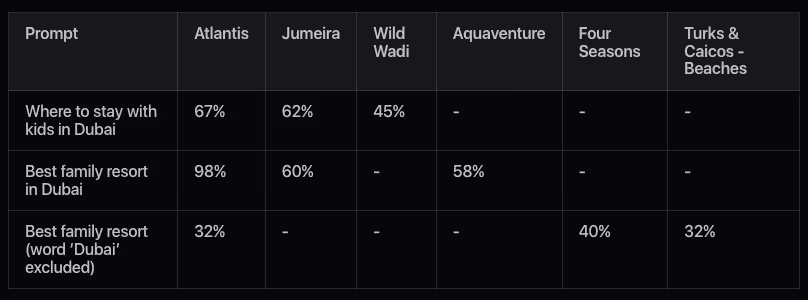
Key Insights:
Atlantis The Palm consistently dominates family-focused prompts when Dubai is explicitly mentioned, achieving the highest AI visibility with scores of 67% and 98% for location-specific queries. However, when the location ‘Dubai’ is excluded from the query, its prominence drops to 32%, allowing global or regional competitors like Four Seasons and Beaches to surface more strongly.
This highlights how AI visibility is highly sensitive to prompt phrasing and contextual cues, underlining the importance for hotels to optimize content for both location-specific and general search intents.
- Brand Signals Outperform Pure SEO: AI engines assess not just how well you rank, but how trusted you are in the hospitality space: structured data, entity clarity, and third-party citations weigh heavily in deterministic, low-temperature (factual) model outputs. If you lack this, you may never show up when AI makes answers based on “what it knows to be true.”
- Regional Engines Are Different, Local Context Matters: In APAC and MENA, local language, culture, and partnerships dramatically influence which hotels are surfaced. For example, Gemini often surfaces regionally optimized content; Perplexity may surface editorial content from local travel media.
AI Engine Comparisons for Hotels: How ChatGPT, Gemini, and Perplexity Affect AI Visibility
Maximizing hotel AI visibility requires understanding how each generative engine interprets your brand content. Not all AI platforms weigh data the same way, and your AI SEO strategy must account for these differences to ensure your property appears in the right answers.
ChatGPT: Structured, Verified, and General Queries
ChatGPT favors structured, well-sourced content. Hotels with rich metadata, comprehensive schema (Hotel, Review, FAQ, LocalBusiness), and credible third-party citations are more likely to appear in responses.
This makes it ideal for broad queries like “best hotels in Singapore” or “top luxury resorts in APAC.” Optimizing content for factual clarity, internal linking, and schema markup increases your likelihood of being referenced across ChatGPT-powered AI answers.
Gemini: Localized Context and Culturally Relevant Content
Gemini prioritizes localized content and culturally specific context. Hotels that highlight local experiences, promotions, and partnerships perform better. For example, a property consistently featuring Singapore’s Marina Bay attractions, local festivals, or dining experiences will achieve higher AI visibility on Gemini.
This engine rewards content that aligns with regional search intent, making it essential for APAC- and MENA-focused hotel marketers.
Perplexity: Editorial and Review-Driven Insights
Perplexity gives weight to editorial coverage, user reviews, and social mentions. Emerging or boutique hotels can gain early visibility by securing high-quality editorial features or guest blog coverage.
For instance, a small hotel highlighted in a reputable travel blog may outrank older chains lacking fresh, review-driven content. This emphasizes the importance of maintaining credible external mentions to enhance AI visibility.
Implications for Hotel Marketing Strategies
A single SEO approach won’t guarantee visibility across all AI platforms. Hotels must adopt a multi-engine strategy to ensure their brands are mentioned across all AI platforms in equal strength.
How can Hotels appear in AI Search?
It may sound alien, but it’s not impossible. This is a 7-step guide we developed for Hotel marketers to apply AI marketing strategies for their brands to appear in AI search.
Step 1: Map Guest Prompts (Fanout Mapping)
- What to do?: Identify about 50 high-value traveler prompts across your market.
- How: Use BrandRadar to run prompt extraction for intents such as “family holiday”, “business stay”, “honeymoon resort”, “budget stay in Dubai,” etc. This gives you a ‘prompt funnel’, which guest questions AI should answer with your hotel. You can track prompt coverage (how many of those prompts mention your hotel).
Step 2: Create Citable, Trustworthy Content
- What to do?: Provide clear facts that AI can reliably cite.
- How: Build trustworthy content such as award pages, reports and FAQ pages based on prompts your guests ask. Identifying your most relevant prompts are key because LLMs prioritize factual and attributed content.
We conducted an experiment in the UAE market focused on National Day brunch searches. For this article, we evaluated 15 prompts out of those, related to Atlantis The Palm across three major brunch intent categories: Luxury Bottomless Brunches, Party Bottomless Brunches, and Casual Brunches.
These prompts were intentionally similar to mimic real consumer phrasing. Below is how often Atlantis The Palm was cited, on average, across ChatGPT, Gemini, and Perplexity within each topic cluster.
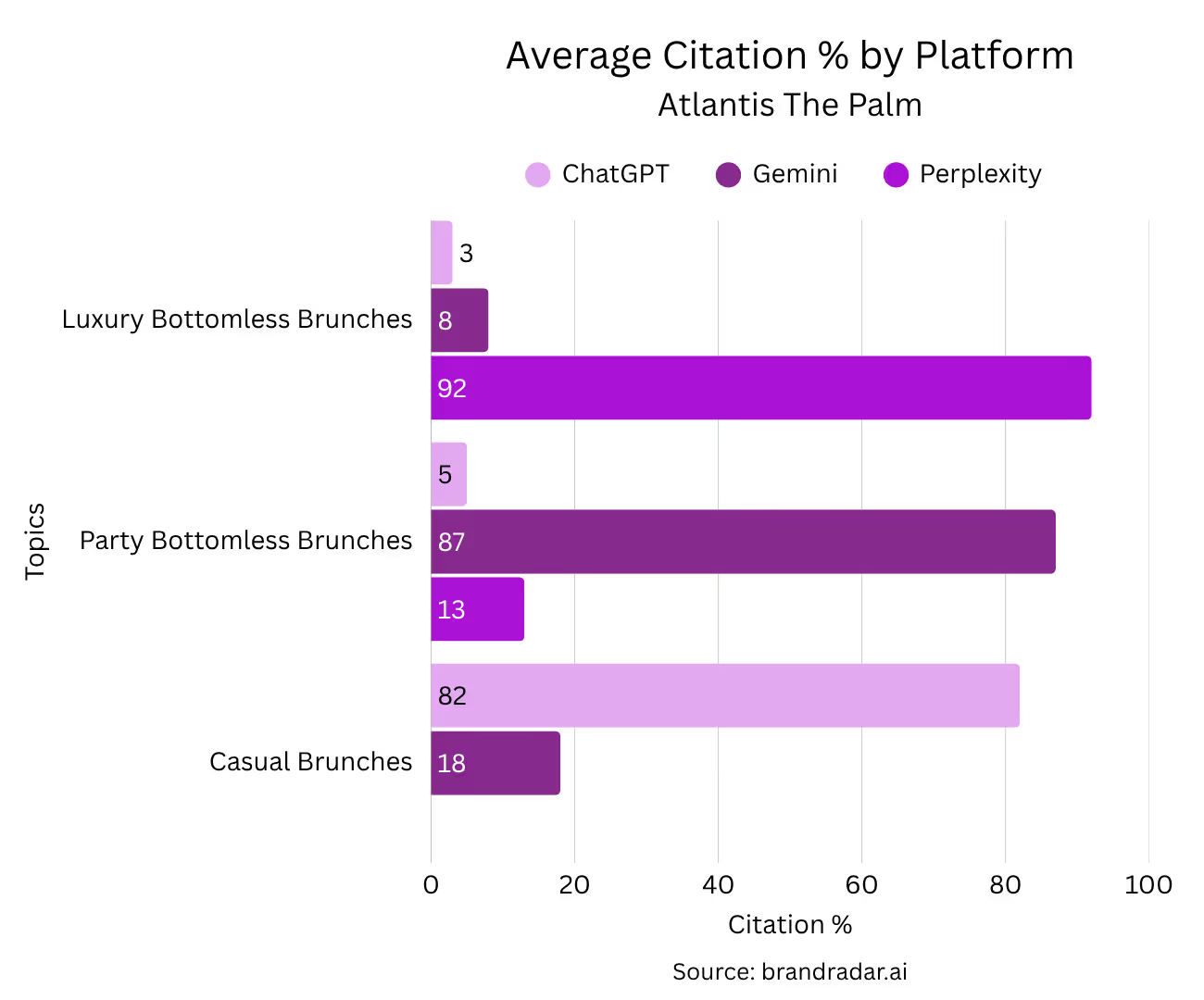
Source: BrandRadar.ai - Hotel Topic Cluster AI Visibility Scores for ‘Atlantis The Palm’
Tested prompts for the analysis
- Best luxury bottomless brunches in Dubai for National Day -
- 5-star hotel bottomless brunches in Dubai this National Day weekend
- Elegant bottomless brunches with champagne in Dubai
- Rooftop bottomless brunches in Dubai for National Day celebrations
- Beachfront bottomless brunches at luxury hotels in Dubai
- Best bottomless brunches in Dubai this National Day weekend
- Popular party brunches with unlimited drinks in Dubai
- Affordable bottomless brunch deals in Dubai for National Day
- Beach brunches with free-flow drinks in Dubai this National Day
- Trending bottomless brunches in Dubai for the long weekend
- Best National Day brunches in Dubai this year
- Popular brunch spots in Dubai for National Day celebrations
- Family-friendly brunches in Dubai this National Day weekend
- Affordable brunches in Dubai for the National Day holiday
- New brunches in Dubai to try for National Day
Key Insights
- ChatGPT overwhelmingly recommends Atlantis for general brunch and family-friendly National Day queries. Perplexity, however, does not mention Atlantis at all
- For party-oriented brunch prompts, Gemini heavily favors Atlantis, more than multiple times higher than Perplexity and infinitely higher than ChatGPT
- Atlantis rarely appears in Luxury-focused prompts on ChatGPT and only minimally on Gemini, while Perplexity strongly favors it
Step 3: Implement Entity-Ready Schema + Semantic Structure
- What to do?: Signal to LLMs exactly who you are, what you do, and why you matter.
- How: On your site, implement schema markup for:
- Organization
- Hotel
- Review
- FAQ
- LocalBusiness
Also include entity mapping: This is done by using consistent naming, alternate names, and internal linking (e.g., “Luxury Family Resorts Abu Dhabi,” “Abu Dhabi beachfront resort”). AI engines build entity graphs and use them to generate answers.
Step 4: Build Content Clusters Around Intent, not Just Keywords
- What to do?: Align content with how guests think, not just what they type.
- How: Develop clusters (topic hubs) based on customer segments:
- Family stays → blog: “Best activities for kids near our resort,” “Family package FAQs”
- Honeymoon → “Romantic dinner by the sea,” “Couple’s suite amenities”
- Business travel → “Meeting room specs,” “Corporate rate policy”
LLMs construct semantic maps connecting related ideas; covering multiple related prompts improves your chances to be cited across intents.
Doing this on your own can be challenging and having no benchmark or visibility status can be like shooting in the dark. Tools like BrandRadar helps create content prompt-basis to gain the ultimate visibility across different queries.
Step 5: Grow Third-Party Citations & Editorial Backing
- What to do?: Build credibility signals through reviews, press, and third-party content.
- How: Partnering with travel editors for features or listicles can help get you started. Besides, you can drive guest reviews on trusted platforms (TripAdvisor, Booking.com, travel blogs) like always and publish your data-driven stories (sustainability, CSR, guest satisfaction) on third-party blogs.
AI models, especially citation-heavy ones like Perplexity, lean heavily on authoritative third-party sources.
Use tools like BrandRadar to track your brand’s sentiments and see how exactly you can build your credibility signals on AI.
Step 6: Localize Your AI Strategy (Region-specifics)
- What to do?: Make your hotel relevant to local travelers and localized AI contexts.
- How: Develop landing pages and content in key languages/currencies (e.g., Arabic, English, Chinese). Additionally you can tie your content to local events (Ramadan offers, Diwali, Chinese New Year). Then use local terms in prompt-related content (“Ramadan getaway in Dubai,” “where to stay in Riyadh for Iftar”).
This helps you first connect with your audience. AI models like Gemini are sensitive to local context and language, boosting your visibility when content is regionalized.
BrandRadar offers region-specific prompt monitoring to help you accurately monitor your Brand’s presence on ChatGPT, Perplexity and Gemini.
Step 7: Test Across Engines & Temperatures
- What to do?: Understand your “AI trust score” by testing how LLMs respond under different conditions.
- How: You can do this by running key prompts with temperature = 0.0 (deterministic) to test “trusted” mentions. You can do this at higher temperatures (e.g., 0.8 – 1.0) to test diversity of mentions and discovery across engines like ChatGPT, Gemini, Perplexity.
If your hotel appears consistently at low temperature, LLMs consider it a factual, reliable brand. If it only appears at high temperature, it may not be sufficiently “known” or “trusted” in the model’s training. Get in touch with our GEO specialists to understand what and how these temperatures work.
AI Visibility in Action - Case Study
A prominent city-center hotel in Singapore partnered with BrandRadar to understand how AI engines like ChatGPT, Gemini, and Perplexity were surfacing their property in response to traveler queries. While the hotel ranked well on Google for certain searches, the same queries yielded little to no mentions across AI platforms.
Through 100+ prompt and citation analyses, we identified key visibility gaps, implemented structured data and schema improvements, optimized content around traveler intent, and aligned their strategy with AI ranking signals.
The results were tangible: the hotel’s AI visibility for core prompts rose from 15–20% to 60–65% on ChatGPT, 50–55% on Gemini, and 70–75% on Perplexity within three months. High-intent queries like “best family hotel Singapore” and “luxury city-center stay” now consistently featured the hotel in AI-generated recommendations.
Key takeaway: Strong SEO alone isn’t enough. By combining structured data, intent-focused content, and targeted prompt testing, the hotel secured measurable AI visibility.
How to measure AI Marketing success for Hotels
Measuring the impact of hotel AI marketing goes beyond traditional KPIs like clicks and impressions. Success is defined by how often your hotel is discovered, cited, and trusted by AI systems across multiple platforms. Here’s how to approach it:
1. Track AI Visibility Across Engines
Use tools like BrandRadar to measure AI visibility, and see how frequently your hotel appears in AI-generated answers on ChatGPT, Gemini, and Perplexity. Visibility is about relevance to guest prompts. Ask yourself:
- Is my hotel showing up for high-intent queries like “best family hotel in Abu Dhabi”?
- Are we cited for niche prompts, such as “eco-friendly resorts in Bali”?
2. Monitor Prompt Share
Prompt share measures your hotel’s presence relative to competitors for the same queries. For example, if AI is asked, “Where to stay in Singapore for business travel?” and your hotel is mentioned 40% of the time across engines, that’s a strong signal of authority in that category.
3. Measure Citation Quality and Source Mix
AI doesn’t just pull facts from anywhere, it prioritizes credible sources. Track:
- Mentions from review sites, editorial blogs, OTAs, and social platforms
- Which domains most influence AI’s recommendation patterns? High-quality citations increase your chance of being surfaced in deterministic, fact-driven answers (low-temperature outputs).
4. Monitor Contextual Coverage
Rather than just counting keywords, assess how your hotel appears across related topics and intent clusters:
- Family travel, business trips, honeymoon packages, local experiences
- Are you mentioned for multiple related prompts, or just a few? Broad contextual coverage increases your chances of being surfaced for diverse guest needs.
5. Analyze Sentiment and Descriptors
AI may describe your hotel using words like “luxury,” “family-friendly,” or “eco-conscious.” Tracking sentiment and descriptive terms helps you understand not just whether AI mentions your brand, but how it frames your property in recommendations.
Conclusion
As travel discovery shifts into conversational AI platforms, hotels that do not optimize for GEO, risk being invisible during key moments of inspiration and decision-making.
By mapping guest prompts, creating factual content, implementing schema, optimizing for intent, building third-party trust, localizing content, and measuring across LLMs and temperature settings, hotel teams can secure meaningful AI visibility, not just in theory, but as a measurable, actionable driver of bookings.
BrandRadar gives you the tools to run this strategy, monitor your performance, and benchmark against competitors.
If you’re ready to lead rather than follow in AI-driven discovery, now is the time to build your GEO foundation. Start your trial today!

