
Afrah Fazlulhaq
Key Takeaways:
- SEO gets your content indexed and ranked. GEO gets your brand recommended.
- AI search prioritizes answers, not links. Being visible inside the response matters more than being on page one.
- GEO and SEO work best together. Treating them as separate strategies creates blind spots.
- Context, trust, and sentiment now drive visibility. Keywords alone are no longer enough.
- Mentions and citations shape AI perception. Authority compounds over time.
- Customer journeys are collapsing. Decisions that once took weeks now happen in minutes.
- Early GEO adoption creates a lasting advantage. Brands that shape AI understanding today won’t scramble tomorrow.
Now that GEO is gaining momentum, businesses are becoming increasingly interested in exploring this space. But what truly is the difference between GEO vs SEO? Let’s start with a simple question.
When someone asks ChatGPT, Gemini, or Perplexity, “Which hotel should I book in Dubai?”
Do they see your brand?
If your answer is “I’m not sure,” you’re not alone.
For years, marketers optimized for Google rankings. Their goal was to get to page one, get the click, and win the traffic.
But today, search doesn’t always look like a list of blue links. It looks like an answer. This shift has given rise to a new discipline called Generative Engine Optimization (GEO), commonly referred to as Answer Engine Optimization (AEO).
We’ll explore all these in this article, so keep reading.
What is SEO?
Search Engine Optimization (SEO) is the practice of optimizing your website to rank higher in traditional search engines like Google and Bing.
Classic SEO focuses on keywords and search intent, technical structure (site speed, indexing, schema), content quality, backlinks, and click-through rates and traffic.
And let’s be clear: SEO is not dead. Your content still needs to be:
- Crawlable
- Indexable
- Structured
- Trustworthy
After all, nearly half the users check Google simultaneously before purchasing anything off AI. That’s normal human behaviour, especially when you’re purchasing high value products you need to be extra sure.
In fact, SEO provides the foundation that AI systems rely on to retrieve information, so it goes hand in hand.
But SEO-only poses a problem.
What Is GEO? (Generative Engine Optimization Explained)
Generative Engine Optimization (GEO) is the practice of optimizing your brand to appear inside AI-generated answers, not just on search result pages. If SEO helps you rank, GEO helps you get recommended.
GEO focuses on how AI models understand your brand, associate you with topics and categories, and decide whether to mention you at all.
Instead of keywords, GEO works with:
- Prompts (the questions people ask AI)
- Context (how your brand is described across the web)
- Citations (what sources AI trusts when mentioning you)
- Sentiment (how positively or negatively AI frames your brand)
- Entity consistency (names, variations, domains)
BrandRadar’s “What Is Generative Engine Optimization?” guide explains this shift clearly.
GEO is part of AEO, the wider umbrella of AI visibility and optimization. Now with GEO/AEO, you cannot rely on backlinks or how strong your keyword optimization is. Sometimes your content doesn’t even have to be original to rank against a competitor.
Unfortunately, space is squeezed in AI. Unlike Google which gives pages of links, on AI engines, only a few brands make it into those answers.
AEO Vs. GEO - What is the Difference?
Answer Engine Optimization (AEO) and Generative Engine Optimization (GEO) are often mentioned together, but they solve different problems in the evolving search landscape.
AEO focuses on helping your content appear as a direct answer to specific questions. It’s about structuring content so search engines and AI systems can easily extract concise, factual responses, often for featured snippets, voice search, or single-answer results.
GEO focuses on how AI models understand, trust, and recommend your brand across entire conversations. It looks at prompt coverage, sentiment, citations, brand consistency, and context. not just whether your content answers a question, but whether your brand is chosen as a reliable option when AI generates recommendations.
In general, both AEO and GEO can be considered in the same context.
GEO vs SEO: The Core Difference
If you’re a marketer in hospitality, GEO determines whether your hotel appears when someone asks “best hotel for business travel.” If you’re in SaaS, GEO decides whether your tool is shortlisted when AI compares vendors.
Though fundamental theories collide, GEO and SEO are two different disciplines that go parallel to each other. Let’s simplify the difference between GEO and SEO.
If SEO asks “How do I rank higher?” GEO asks “Why would AI choose me over others?”.
This shift is also reshaping how customers make decisions. Traditionally, the top, middle, and bottom of the funnel unfolded in a fairly linear journey, often taking 15 days or more and involving 10+ touchpoints before a decision was made.
Today, that entire process can happen in hours or even minutes. AI accelerates discovery by collapsing the funnel, giving users answers and recommendations instantly rather than forcing them to research, compare, and evaluate across multiple steps.
Adding to this change, AI also actively gathers information from across the web before it ever looks at your website. Reddit discussions, Quora threads, PR coverage, third-party articles, and even older or archived content can all influence how AI understands and presents your brand.
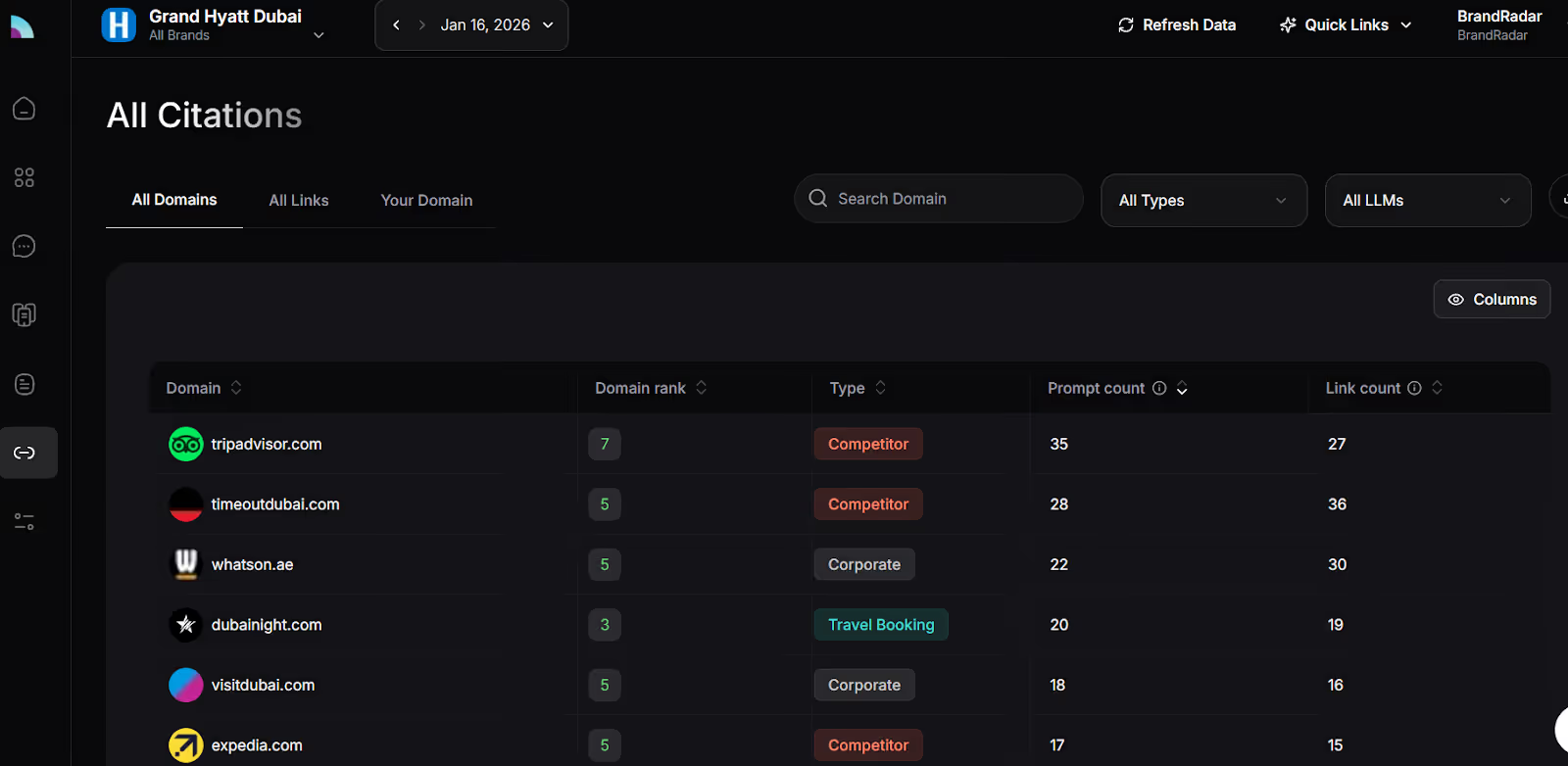
In many cases, what others say about you matters just as much, if not more, than what you say about yourself.
SEO Is Built for Clicks While AI Is Built for Answers.
In traditional search, ranking #5 still mattered because users scrolled past the first 3 links. As long as you were on the first page of Google, your visibility was at 80% or more.
But in AI-powered search, there may be no click at all.
A recent BrandRadar research on Long-tail keyword hospitality study across 4 markets showed that AI answers often cite 3-5 brands max
It’s also normal for many queries to end without users ever visiting a website. Decisions now happen inside the answer itself.
That’s where SEO alone starts to fall short.
GEO Prefers Context Over Content
While content is still the core driver of discoverability, GEO demands a different standard for what “good content” actually means.
It’s not about stringing together keywords or publishing content at scale. For AI, content must be contextually relevant, clearly structured, and aligned with real user intent. AI systems generate answers, while search engines present information for users to choose from.
That distinction is why the concept of Answer Engine Optimization (AEO) exists, and why GEO builds on it.
Brands Are More Likely To Get Mentioned By AI
Google focuses on providing the sources that most likely contain the answer for your question, while AI offers the answer that you need to make a decision. If you want to make a purchase, AI engines help you by providing the solution, and it's often brands that make it to the list.
Why SEO Alone Is No Longer Enough
While SEO was enough to get by back in 2025, this year things seem a bit more competitive. Brands are competing for AI answers making ranking on AI more challenging by the day.
This means only a few brands get a chance at exposure, trust signals matter more, and mentions compound over time.
Even if your SEO is excellent, AI may still ignore you.
Today, a growing percentage of searches end with no clicks as AI answers compress the funnel. This means being ranked doesn’t mean you’re being visible.
GEO Doesn’t Replace SEO, It Builds on It
One of the biggest misconceptions marketers have is that GEO replaces SEO.
It doesn’t. In simple terms, SEO can be viewed as the input layer, while GEO is the interpretation layer.
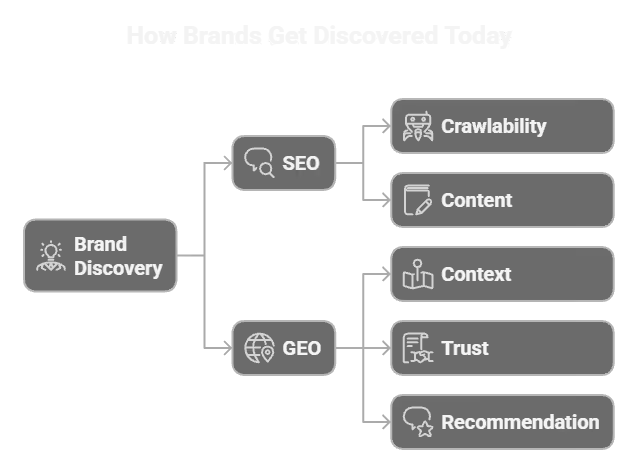
When done together, they reinforce each other. When done separately, they leave gaps.
How GEO and SEO Work Together in Real Life
Example 1: Hospitality Brand
A hotel might rank well on Google for broad searches like “luxury hotels in Dubai” thanks to strong SEO. That visibility helps with discovery, but it doesn’t guarantee inclusion in AI-generated answers. When travelers ask AI platforms a more specific question such as “best hotel for business travelers in Dubai,” the decision process changes.
Further, intent modifiers have a 70% of changing answers. Which means if you search for the same question with one or two intents changed, you may get completely different answers.
BrandRadar’s hospitality visibility studies show that hotels with strong citation coverage, positive sentiment, and consistent brand naming are far more likely to be recommended by AI, even when their traditional SEO rankings are nearly identical to competitors.
Example 2: SaaS / API Platform
The same pattern applies in the SaaS space. A software company may rank well for a generic keyword like “best payment API,” but AI-generated answers are built from a much broader set of signals. Instead of relying solely on search rankings, AI systems pull information from GitHub repositories, technical documentation, developer forums, and third-party review sites.
Brands with clear and well-maintained documentation, neutral-to-positive sentiment across developer communities, and repeated mentions in trusted technical sources consistently perform better in AI recommendations. In these cases, contextual authority and credibility matter far more than raw keyword rankings alone.
How to Start GEO Without Breaking Your SEO
The good news is that you don’t need to rebuild everything. Currently AI retrieves information from indexes that are already on Google. So the source information will always be one, but the method of retrieval is where brands must look into.
Sometimes your content might be originally written, hence it may rank well on Google, but it lacks structure and the context is buried deep with vague statements, this may cause your brand to disappear on AI engines.
Most SEO practices follow a systematic approach of optimizing content for organic growth, which heavily depends on keyword stuffing, whereas AI focuses on entity trust signals.
Here’s a simple approach that we follow when serving our clients:
- Audit your existing SEO content
- Map the prompts your audience actually asks AI
- Align content to answer-first intent
- Monitor AI mentions and citations
- Track sentiment over time
Before you get started on GEO, it’s always best to fix any lingering SEO problem. As both concepts are fundamentally similar, starting off with the basic structuring is a safe space.
The key to managing both GEO and SEO is tracking the performance of your prompts and query performance frequently. Google is often direct and trackable, but AI answers waver. Though entity strength compounds over time, it’s yet to be studied.
Common Myths About GEO vs SEO
GEO answers don’t come out of thin air, they pull from the same web your SEO efforts have been building for years. Your technical SEO, structured pages, and well-written content form the foundation that AI systems retrieve and interpret. Without strong SEO, there’s very little for GEO to work with in the first place.
GEO kills SEO
This is one of the most common fears we hear from marketing teams. The idea that optimizing for AI means abandoning SEO couldn’t be further from the truth. In reality, GEO depends on SEO. AI models don’t create answers out of thin air, they pull from the same web your SEO efforts have been building for years.
Your technical SEO, structured pages, and well-written content form the foundation that AI systems retrieve and interpret. Without strong SEO, there’s very little for GEO to work with in the first place.
AI ignores websites
It might feel like AI is bypassing websites entirely, especially when answers appear without clicks. But behind every AI-generated response is content sourced from real web pages.
AI systems rely heavily on structured, authoritative content, from blogs and documentation to trusted media sites and knowledge bases. If your content isn’t clear, well-organized, and credible, AI struggles to understand and trust it.
In many ways, AI is even more selective than search engines about where it pulls information from.
Mentions don’t matter
In traditional SEO, backlinks were the gold standard for authority. In the world of AI, mentions play a similar role. When AI sees your brand repeatedly referenced across trusted sources, even without direct links, it begins to associate your name with expertise and relevance.
Mentions help AI build confidence in your brand, shaping whether you’re included in answers or quietly left out. In other words, mentions aren’t just noise; they’re how AI learns who to trust.
How to Write GEO and SEO Content?
One of the biggest concerns marketers have when they first hear about GEO is this:
“If we start writing for AI, will it hurt our SEO?”
The short answer is no, not if it’s done correctly.
In fact, the strongest content strategies today are built on both SEO and GEO working together, not competing with each other. The key is understanding how content is read by search engines versus how it’s interpreted by AI models.
1. Start With Search Intent, then Expand to Prompt Intent
Traditional SEO content begins with search intent. You identify a keyword like “best CRM software” and create a page designed to rank for that term. GEO content starts one layer deeper, which is prompt intent.
Instead of asking “What keyword do we want to rank for?” You also ask, “What question is the user asking an AI, and what kind of answer does AI need to give?”
For example:
- SEO keyword: Best CRM software
- GEO prompts:
- “What’s the best CRM for small teams?”
- “Which CRM integrates well with HubSpot?”
- “Best CRM for remote sales teams”
Each of these prompts carries slightly different intent, and AI expects content that addresses those nuances directly. While Google would ideally cluster all these under the keyword/phrase ‘Best CRM software’, AI caters to each of these long-tail keywords separately. In GEO, Long-tail keywords play a much bigger role.
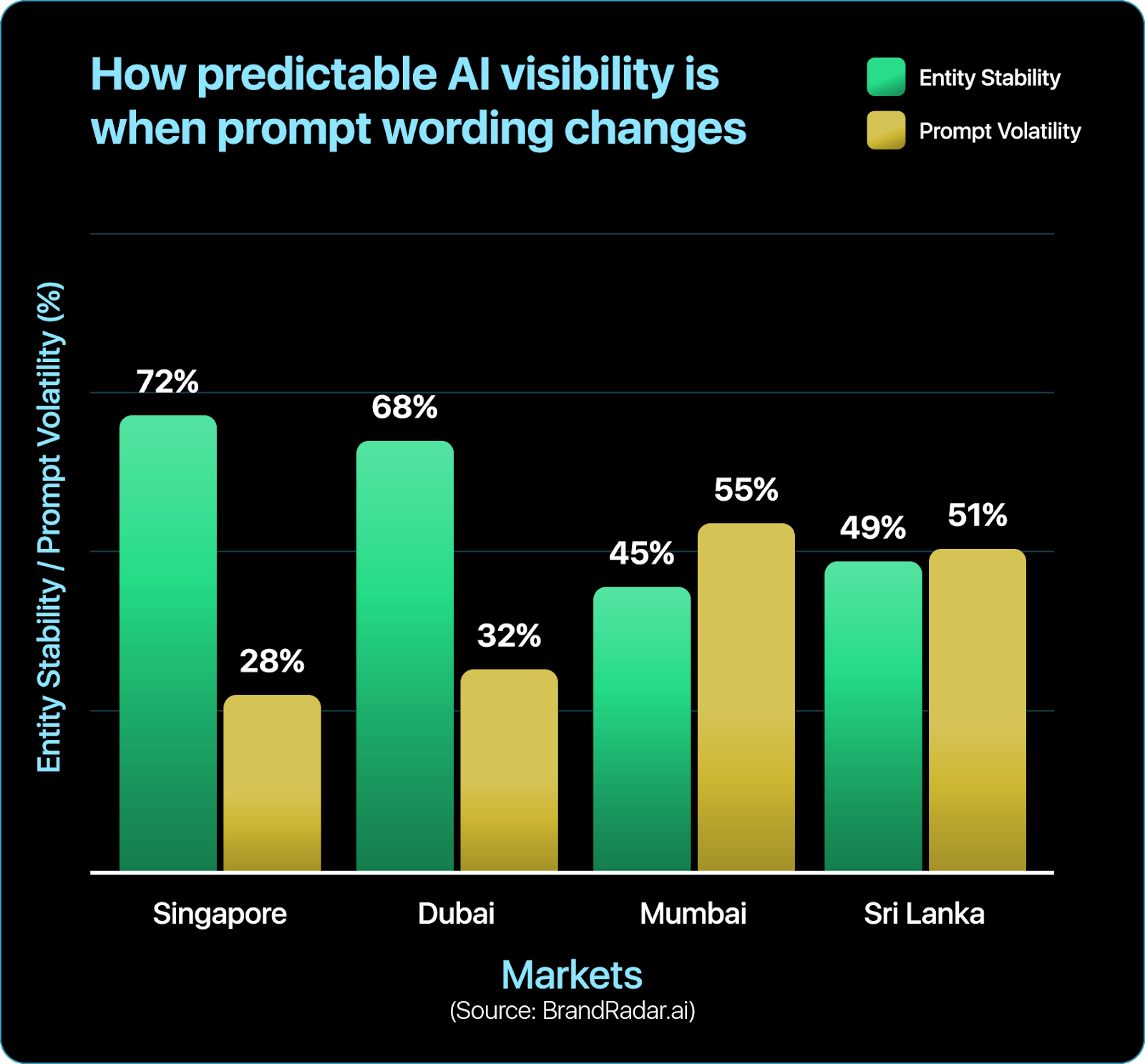
The chart above shows how brand recommendations change when prompt wording changes. Outside of highly structured markets, much of the hospitality industry has medium to low predictability, meaning even small variations in phrasing can result in completely different brand suggestions.
This is where BrandRadar comes in.
BrandRadar uses its proprietary intelligence engine to analyse all these for you:
- Live AI prompts across ChatGPT, Gemini, and Perplexity
- Prompt variations and fan-out
- Competitor visibility per prompt
- Gaps where your brand is missing
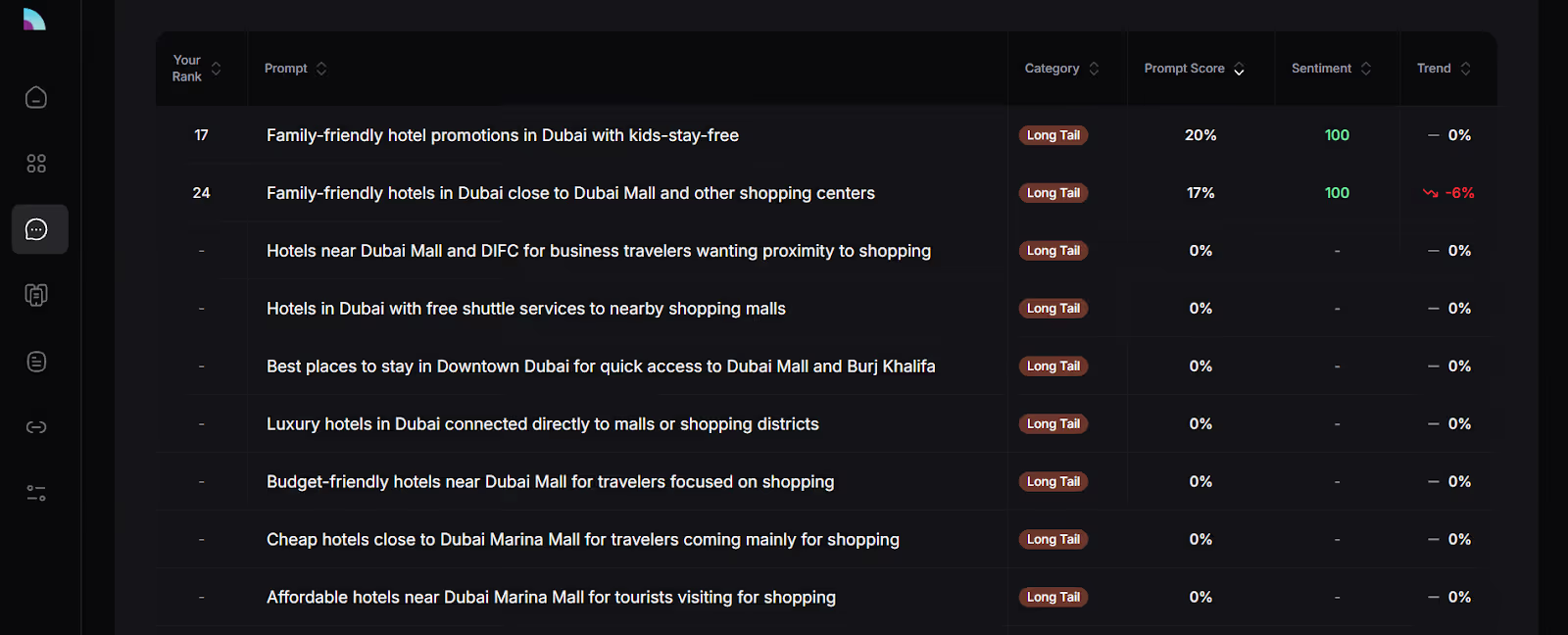
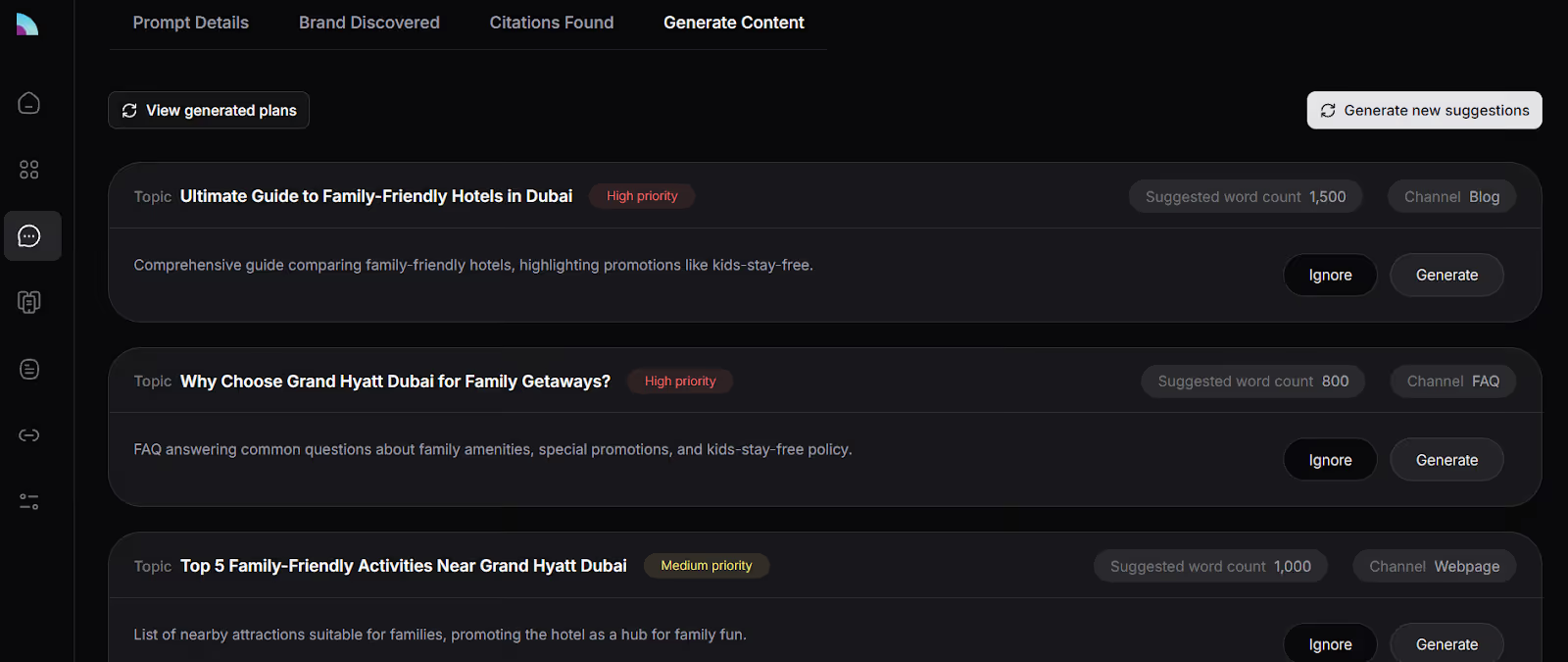
Instead of guessing what to write, you’re given exactly which prompts matter, and which ones you should build content around.
2. Write Answer-First Content (Then Layer SEO Depth)
AI models don’t scan pages the same way search engines do. Where SEO favors, headings, keyword placements, internal links, depth and structure, AI prefers clear answers, logical flow, contextual explanations and trusted references.
That’s why GEO-friendly content should be answer-first. For example, instead of opening with “In today’s fast-paced digital world…”
Start with “The best CRM for small teams is one that balances ease of use, automation, and pricing.”
From there, you expand:
- Explain why
- Provide examples
- Add supporting sections
- Include structured headings for SEO
This approach does not hurt SEO. In fact, it often improves featured snippet eligibility, time on page and content clarity.
BrandRadar’s content insights highlight how AI reads your existing pages, helping teams restructure content so it serves both audiences: humans and machines.
3. Build Context, Not Just Keywords
SEO content historically focused on keywords and synonyms. GEO content focuses on contextual relevance.
AI asks:
- Is this brand consistently associated with this topic?
- Do multiple sources describe the brand the same way?
- Does the content align with the broader conversation around this subject?
For example, a hospitality brand writing about “business travel hotels” needs more than keyword optimization. AI looks for mentions in travel blogs, OTAs, reviews that mention business amenities, articles describing meeting spaces, Wi-Fi, location, service
We analyze context signals across the web at BrandRadar, showing:
- Which topics AI associates with your brand
- Where competitors are stronger contextually
- What themes you need to reinforce through content
This allows teams to create content that doesn’t just rank, but makes sense to AI.
4. Optimize for Citations and Trust Signals
In SEO, backlinks signal authority, while in GEO, citations and mentions signal trust.
AI models rely heavily on blogs, news sites, documentation, forums, Wikipedia and social content.
When writing GEO-friendly content, it’s important to reference credible sources, publish content that others can cite, maintain consistent brand naming and avoid conflicting descriptions of your product or service.
BrandRadar’s citation intelligence report will show you:
- Which domains AI cites most often
- Where your brand appears (or doesn’t)
- What citation types influence AI answers (e.g. news, social, wiki)
5. Optimize content for better AI parsing
One of the core principles of GEO is making sure your content is easy for AI systems to understand, interpret, and reuse. AI-ready content is structured, clear, and context-rich. It answers questions directly, uses consistent terminology, and supports claims with credible sources.
When content is optimized this way, AI models can parse it more accurately, connect it to the right prompts, and confidently include your brand in generated answers.
6. Track your Performance Frequently
Just like SEO, GEO isn’t a one-time effort. AI models update frequently, which means your visibility can change just as fast. That’s why ongoing monitoring matters, and why measuring your AI visibility is essential.
The Future of Search: What Marketers Must Prepare For
Search is becoming about making decisions. As AI-powered systems increasingly sit between users and the web, the way people discover brands, products, and services is fundamentally changing.
Instead of scanning ten links, users now expect direct answers, curated recommendations, and even guided choices, all delivered instantly by AI. This shift brings four major changes every marketer needs to prepare for.
Answers-Focused Responses
One of the most visible changes in search today is the decline in clicks. AI-generated answers often resolve a query before a user ever visits a website. Whether it’s ChatGPT summarizing options, Gemini recommending services, or AI Overviews on Google, the search journey is becoming shorter and more compressed to respond as a single answer.
For marketers, this means traditional success metrics like traffic alone are no longer enough. Visibility now happens inside the answer itself. If your brand isn’t mentioned, cited, or framed positively, it effectively disappears from the decision-making process.
From Rankings to Recommendations
AI systems recommend outcomes. Instead of presenting a list and letting users decide, AI often narrows the field to just a few options. This shift places enormous importance on how AI evaluates trust, relevance, and authority. Being “one of many” is no longer viable. You either make the shortlist, or you don’t appear at all.
This is where Generative Engine Optimization plays a critical role. GEO focuses on helping AI understand why your brand should be included, not just where your page ranks.
The Rise of Agentic AI
We’re also entering the era of agentic AI, systems that don’t just answer questions, but take action on behalf of users.
These AI agents can compare vendors, shortlist options, recommend purchases, book services or trigger automated workflows.
For marketers, this changes everything. Your brand is being evaluated by an intelligent system that weighs context, credibility, and prior signals before making a choice.
If your brand isn’t clearly understood or trusted by these systems, you may never enter the consideration set at all.
Trust-Based Discovery Becomes the Default
As AI becomes the primary interface for discovery, trust becomes the currency of visibility. AI systems rely on consistent brand mentions, positive sentiment, credible citations, clear positioning, and repeated validation across sources
This moves discovery away from pure keyword optimization and toward reputation-driven visibility. Brands that invest in building consistent, trustworthy narratives across the web will surface more often.
Those that don’t will fade, quietly and quickly. GEO gives marketers a way to measure and manage this trust at scale.
AI Shapes Decisions
Perhaps the most important shift of all is that AI doesn’t just inform users, it influences outcomes.
When AI suggests which hotel to book, which tool to use, or which brand to trust, it shapes real business decisions. That means visibility inside AI systems directly impacts revenue, pipeline, and growth.
Brands that understand GEO early gain a compounding advantage. They shape how AI systems learn about them today, rather than scrambling to correct narratives later when visibility gaps become harder to close.
Frequently Asked Questions
- Is GEO replacing SEO?
No. GEO does not replace SEO, it builds on it. SEO ensures your content is discoverable and indexed by search engines, while GEO helps your brand get mentioned, cited, and recommended inside AI-generated answers. The strongest strategies use both together.
- How long does GEO take to show results?
GEO results can appear faster than traditional SEO, especially for brand mentions and AI visibility. However, trust and entity strength compound over time. Most brands begin seeing early shifts in weeks, with stronger momentum building over months.
- Is GEO relevant for small businesses or only enterprises?
GEO is relevant for businesses of all sizes. In fact, smaller brands can benefit significantly by owning niche prompts, building strong context, and earning trust signals early, even when competing against larger brands.
- Do backlinks still matter in GEO?
Backlinks still matter for SEO, but GEO places greater emphasis on mentions and citations. AI models assess authority through repeated, consistent references across trusted sources, even without direct links.
Final Takeaway: SEO Builds the Road. GEO Controls the Traffic
SEO lays the groundwork by helping your content get discovered, indexed, and ranked. It ensures your brand exists where search engines can find it. GEO builds on that foundation by helping your brand get chosen, surfaced, cited, and recommended inside AI-generated answers where decisions now happen.
The GEO vs SEO conversation isn’t about picking one over the other. The real advantage belongs to brands that understand how both work together.
That’s why BrandRadar doesn’t treat GEO and SEO as separate efforts, but as a connected system designed to work in sync, without compromising either.
Ready to get your brand discovered on AI and search? Book a call with the experts at BrandRadar today.

