
Afrah Fazlulhaq
Key takeaways:
- Generative Engine Optimization (GEO) is the practice of optimizing your content, structure, and entity signals so AI models like ChatGPT, Google Gemini, and Perplexity cite and recommend your brand inside their answers.
- GEO is not a replacement for SEO, it extends it. GEO helps you appear in AI-generated answers, which are rapidly becoming the new discovery layer.
- Traditional search rewards clicks and backlinks; generative search rewards authority, structured data, semantic clarity, and credible citations.
- Brands that aren’t cited by AI assistants risk vanishing from the first point of discovery, even if they dominate Google rankings.
- This guide breaks down GEO into four core pillars: entity optimization, citation trust, AI-friendly content, and structured data.
- You’ll also learn the 5 essential GEO strategies marketers are using today to appear in AI results, plus the biggest risks to avoid.
- Finally, you'll see how tools like BrandRadar help brands measure their AI visibility, track citations across models.
The search shift marketers keep talking about isn’t coming, it’s already here. Just a few years ago, the idea of asking an AI assistant for travel recommendations, product comparisons, or business advice seemed futuristic. As per BrandRadar’s research, millions of people start their day by asking ChatGPT, Google Gemini, or Perplexity instead of typing queries into a traditional search engine. This is where GEO comes in. So what is Generative Engine Optimization?
In this comprehensive guide, you'll learn:
- What GEO really means, and how it fundamentally differs from SEO
- Why it's becoming critical for brands across every industry
- Proven strategies for successful GEO implementation
- Common risks and pitfalls to avoid
- What the future holds for AI-driven discovery
Whether you're a marketing director or a CMO at an enterprise looking to increase bookings, or an agency helping clients stay ahead of the curve, this guide will give you the framework you need to thrive in the age of generative AI.
Generative Engine Optimization (GEO) 101
What is Generative Engine Optimization (GEO)?
Generative Engine Optimization (GEO) is the discipline of tailoring your content, structure, and digital presence so that AI-powered models cite, reference, and trust your brand in their summarized responses.
It's not just about being found. It's about being quoted, trusted, and recommended by the AI assistants that are rapidly becoming the world's most influential information gatekeepers.
How GEO Works
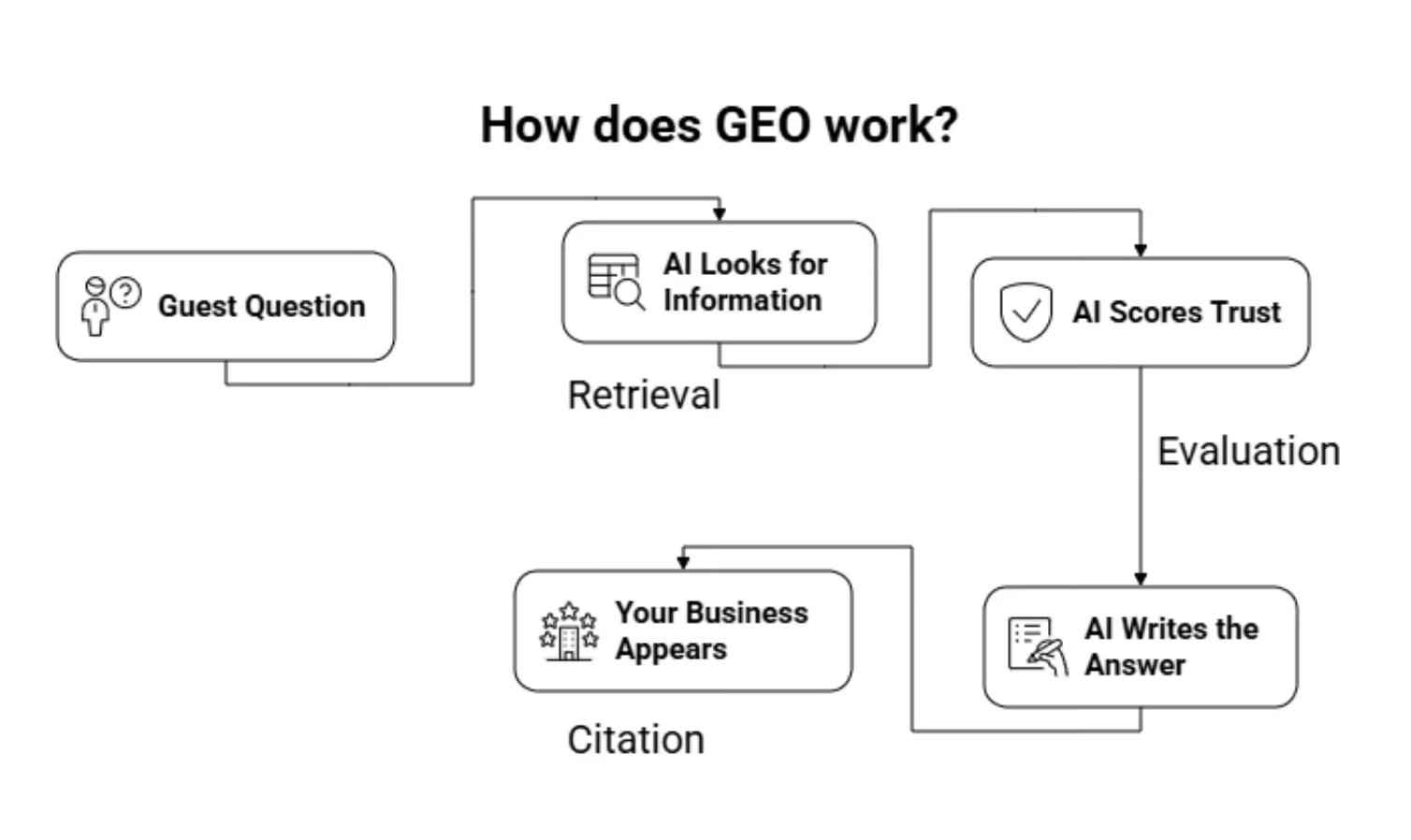
GEO Optimization works by aligning your brand with how AI answers questions. When a user prompts an AI, the model retrieves credible sources, scores them for trust and relevance, and generates a response. Brands with clear entities, strong citations, and structured information are most likely to be referenced and included in the final answer.
Here’s how it would look in a visual flow.
AI SEO vs. AEO: What’s the Difference?
We get this asked frequently, and here’s the technically accurate answer. AI SEO (a.k.a. GEO or AI Search Optimization) focuses on structuring your content so AI models can understand it. These include clear entities, structured data, authoritative signals, and factual consistency.
AEO (Answer Engine Optimization) focuses on optimizing your content so AI assistants will use it, appearing in summaries, recommendations, and direct answers. One can call it the umbrella term for AI visibility.
AI SEO Example:
You add structured data, clear entity descriptions, and strong factual signals to your product page. This helps AI models correctly understand what your software does.
AEO Example:
When someone asks an AI, “What are the best CRM tools for small teams?”, your brand is actually mentioned in the answer because authoritative third-party content, citations, and trust signals support it.
GEO Vs. Traditional SEO
While SEO and GEO share some foundational principles, like the importance of quality content and authoritative sources, they diverge in critical ways:
The most important difference? SEO optimizes for human behavior (clicking, browsing, navigating). GEO optimizes for AI behavior (understanding, trusting, citing).
The Four Core Pillars of GEO
To succeed with Generative Engine Optimization, you need to master four foundational pillars :
1. Semantic Structure & Entity Optimization
AI models don't just read your content, they interpret it through entities and relationships. An entity is any distinct concept: your brand, your products, your people, your locations.
Using structured data formats like schema.org markup (specifically JSON-LD), you can explicitly define these entities and their relationships. This helps AI models understand not just what you do, but who you are in the broader context of your industry.
For example, if you're a hotel brand, schema markup can tell AI engines:
- Your exact name and spelling variations
- Your physical locations
- Your relationship to parent companies or franchises
- Your amenities, reviews, and booking options
- How you relate to other entities like tourist destinations or events
The more clearly you define these relationships, the more confidently AI can cite you.
2. Trust & Citation Signals
Generative engines prioritize sources they consider authoritative. This isn't just about domain authority in the traditional SEO sense, it's about being cited in the publications, research papers, databases, and expert resources that AI models use as training and retrieval sources.
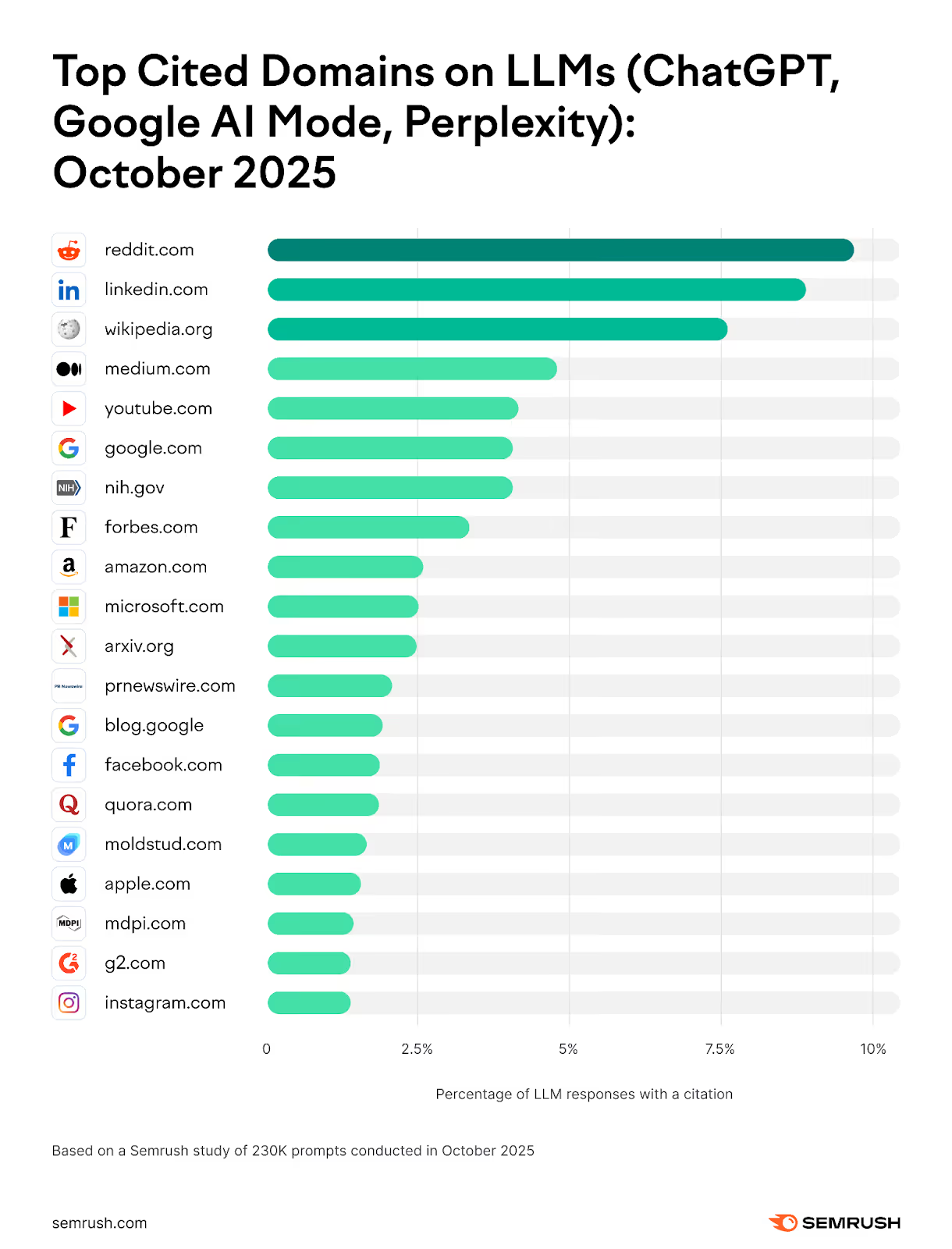
The above study by Semrush in October 2025 lists the top cited domains on AI platforms. Despite Reddit dropping drastically on ChatGPT following updates, they still managed to claim the #1 position.
To build citation trust:
- Publish original research, data reports, or proprietary studies
- Earn placements in respected industry publications
- Get mentioned in academic papers, whitepapers, and credible media outlets
- Create thought leadership content that other experts reference
- Build relationships with journalists and analysts who cover your space
Think of it as building your brand's reputation in the eyes of AI, one authoritative mention at a time.
3. AI-Friendly Content Formats
Not all content is created equal when it comes to AI consumption. LLMs prefer content that's modular, clearly structured, and semantically self-contained.
The formats that work best for GEO Optimization include:
- FAQ pages that mirror how people naturally ask questions
- Q&A sections with direct, complete answers
- Listicles and step-by-step guides that break complex topics into digestible chunks
- Definition sections that clearly explain concepts
- Comparison tables that present information in structured formats
Each piece of content should work as a standalone answer that AI can extract and cite without needing additional context.

BrandRadar’s content plan feature identifies content gaps and provides brands with the exact type of content they need to start ranking on AI platforms.
4. Schema and Structured Data Implementation
This deserves special emphasis because it's where many brands fall short. Implementing proper schema markup, using formats like Organization, FAQPage, Article, Person, Product, HowTo, and Review, gives AI models a machine-readable blueprint of your content.
Without this structured data layer, even your best content might be overlooked simply because AI can't confidently parse what it means.
The Rise of Generative Search Engines
How is SEO Changing?
Forbes names ChatGPT, the fastest growing app in web history.
Traditional search engines like Google built their empires on a simple model: crawl websites, index their content, analyze backlinks, and rank pages based on hundreds of signals. Users would scan through results, click a few links, and piece together their own answers.
Generative engines flip this model on its head. They lean on retrieval and generation rather than ranking and clicking.
They understand content semantically, not just through keywords, but through meaning, context, and relationships. This creates a fundamentally different dynamic. In traditional search, visibility meant being on page one. In generative search, visibility means being inside the answer.
The Behavioral Shift That's Reshaping Discovery
As mentioned earlier, users are increasingly turning to AI for tasks that used to belong to Google. What’s more compelling is that this comes with strings attached. An Ahrefs study found 7 in 10 searchers never read past the first third of an AIO.
In each of these scenarios, AI is becoming the new starting point for discovery. It's the first place people go to learn, decide, and act:
- Research and recommendations: "What are the best CRM tools for a travel agency with a small sales team?"
- Complex question answering: "How can a boutique hotel improve visibility on AI assistants like ChatGPT and Gemini?"
- Content summarization: "Give me the main takeaways from the latest SaaS customer acquisition benchmark study."
- Personalized advice: "Based on my hotel’s target audience, what marketing channels should I focus on next year?"
And brands that ignore this shift risk being left out of those critical first moments of decision-making, the moments that shape perception, preference, and purchase intent.
Why GEO Is Critical for Brands Today
The AI Visibility Crisis No One's Talking About
You could have the best SEO in your industry, rank #1 for dozens of high-value keywords, and still be completely invisible in AI-generated responses.
An Ahrefs study in May 2025 found out AI Overviews reduce clicks by 34.5%. And that’s just the start.
Why? Because generative engines don't necessarily prioritize the same signals that traditional search algorithms do. They care about semantic clarity, structured data, authoritative citations, and content that directly answers questions.
This creates a dangerous gap. Brands that have invested years building their SEO presence assume they're visible everywhere that matters.
But when their target customers ask ChatGPT or Perplexity for recommendations, they're nowhere to be found, and they don't even know it.
Building AI Trust & Authority
Think of AI search optimization as a new form of brand equity. Just as you've worked to build trust with human audiences through consistent messaging, quality products, and customer service, you now need to build trust with AI systems through structured content, authoritative citations, and semantic clarity.
The brands that win in this new landscape won't just be those with the biggest marketing budgets. They'll be the ones that understand how to communicate in a language AI models understand and value.
The Competitive Window Is Closing
Right now, Generative Engine Optimization is still an emerging discipline. Most brands aren't actively optimizing for it, which means there's a significant first-mover advantage for those who do.
A study by Salesforce, 2025 found that 63% of marketers already use AI tools to analyze market data.
By 2026, a significant number of marketers will start ranking for AI. As more companies recognize the importance of AI visibility optimization, the competition for citations will intensify. The brands that start building their GEO foundation today will have a structural advantage that becomes harder to overcome as the space matures.
The Cost of Inaction
Let's be direct about what's at stake. According to Forbes 2025, leads originating from ChatGPT are almost 7X more likely to convert to paying customers than those from Google.
What’s more? If you don't adapt to generative search:
- You lose discovery opportunities as users increasingly bypass traditional search
- Competitors shape the narrative in your category without your input
- You miss the trust-building phase when AI systems are learning which brands to cite
- You waste resources optimizing for channels that are declining while ignoring ones that are rising
- You risk irrelevance in the very spaces where your future customers are making decisions
The question now is whether you're willing to wait until you've already lost ground.
5 Core Strategies for Generative Engine Optimization
Now that you understand what GEO is and why it matters, let's get tactical. Here are the proven strategies that drive results in this day and age. Keep in mind that measuring AI visibility is just as crucial as rolling them out.
1. Content Structuring for AI Consumption
The way you structure your content has a massive impact on whether AI can easily extract and cite it. ChatGPT best practices in writing for machines and humans isn’t too complicated.
2. Building Authority Through Strategic Citations
Your GEO success is directly tied to where else your brand appears on the web, especially in sources that AI models consider authoritative. Each authoritative mention becomes a signal to AI that your brand is a credible source worth citing.
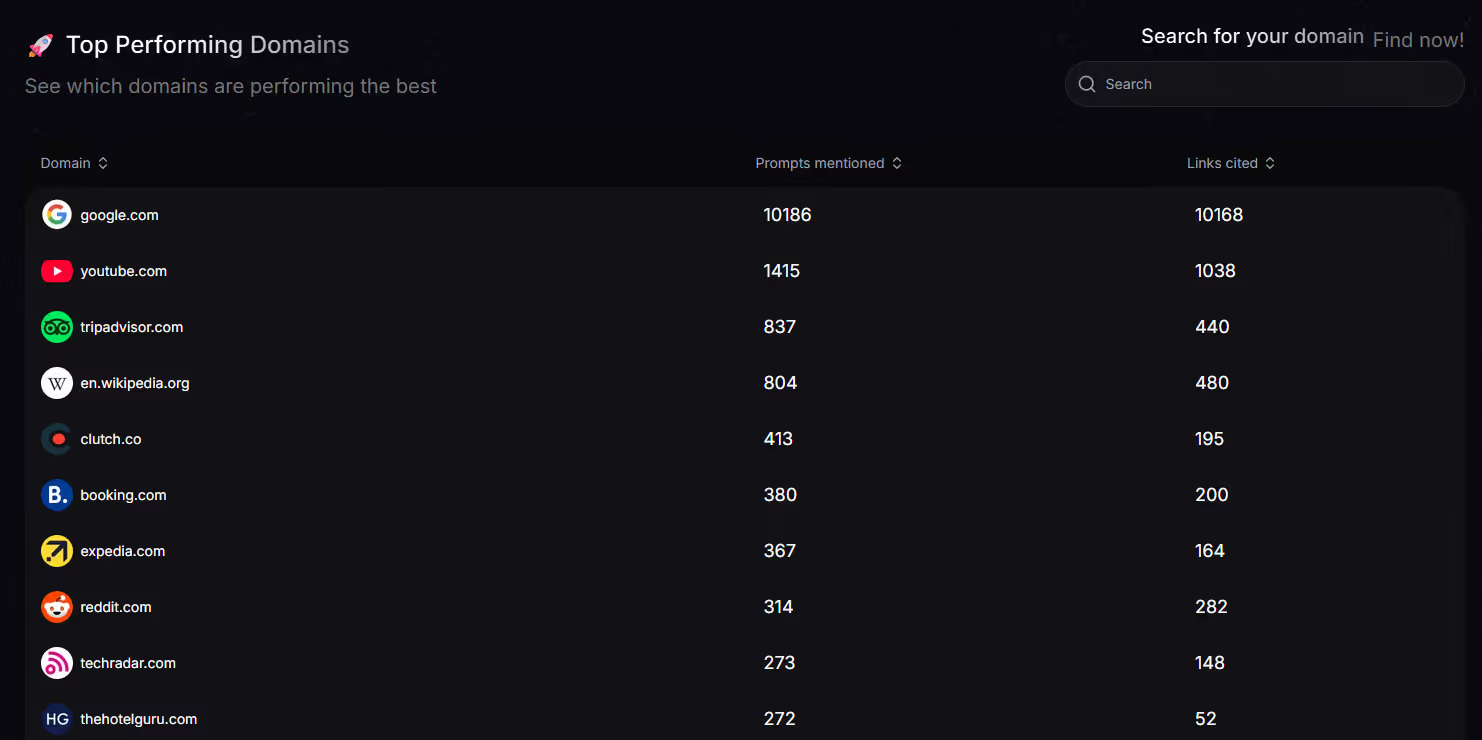
BrandRadar’s public index (shown above) analyzes 10,000+ prompts via the platform for 600+ brands across hospitality and other industries, with the top 10 most-cited domains across all these prompts and intents.
3. Schema & Entity Graph Optimization
This is where technical SEO meets GEO. Implementing comprehensive schema markup helps AI models understand your content with precision.
Beyond individual pages, think about your entity graph, the interconnected web of relationships between your brand entities, products, people, and concepts. Use internal linking and consistent naming to reinforce these relationships across your site. Certain brands are adopting llms.txt which is a questionable standard for ranking.
4. Prompt-Aware Content Strategy
Traditional SEO focused on keywords. Generative Engine Optimization focuses on prompts, the natural language questions and requests users make to AI systems.
How to build a prompt-aware strategy:
- Research common prompts in your category (e.g., "What are the best project management tools for remote teams?")
- Map your content to high-value prompts where you want to be cited
- Optimize for question formats: "what is," "how to," "why does," "where can I," "when should"
- Create content that directly answers these prompts in the first few sentences
- Test your visibility by actually querying AI systems with these prompts
- Track performance using tools like BrandRadar to see where you're being cited and where you're not
The brands winning at GEO aren't guessing what content to create. They're systematically mapping the prompt landscape in their industry and filling gaps strategically.
5. Multi-Model Testing & Optimization
Different AI models have different preferences, training data, and citation patterns. What works for ChatGPT might not work as well for Gemini or Perplexity.
The most sophisticated GEO practitioners treat this like conversion rate optimization, constant testing, measurement, and refinement based on data.
Tools & Platforms for GEO Measurement
You don’t have to shoot in the dark anymore with GEO. Platforms like BrandRadar become essential. While you can manually query AI systems, scaling this to dozens or hundreds of prompts across multiple platforms quickly becomes impossible.
The best tools for Generative Engine Optimization are built around AI visibility offering.
What are the Challenges and Risks of GEO
No strategy is without challenges. Here's what to watch out for as you build your GEO program.
The Content Quality vs. Optimization Tension
There's a real risk of over-optimizing AI at the expense of human readability. Content that's too structured, too keyword-focused, or too clinical might perform well with AI but fail to engage actual readers. Don’t forget Google still brings a considerable amount of users to you.
The solution is to Optimize for both. Write for humans first, then add the structural elements (schema, clear headings, modular formats) that help AI understand and cite your content. Quality and optimization aren't mutually exclusive, they're complementary.
Rapidly Shifting AI Behavior
AI models update frequently. ChatGPT-5 behaves differently than ChatGPT-4. Google's Gemini changes with each new release. What works today might not work in three months.
This means your GEO strategy can't be static. You need to:
- Continuously test and measure across platforms
- Stay informed about model updates and changes
- Build flexible content that adapts to different AI behaviors
- Maintain a portfolio approach rather than betting everything on one platform
Think of GEO as an ongoing discipline, not a one-time project.
Ethics, Accuracy, and AI Hallucinations
AI models sometimes hallucinate, they generate confident-sounding information that's actually false. If an AI misrepresents your brand, product, or claims, it can damage your reputation.
Risk mitigation strategies:
- Monitor AI mentions by actively using tools like BrandRadar
- Provide clear, accurate information about your brand in structured formats to reduce ambiguity
- Build authoritative citations from trusted sources that AI will prioritize
- Report inaccuracies to platform providers when you find them
- Maintain transparent source documentation so AI can verify claims
You can't control AI completely, but you can significantly influence how it understands and represents your brand.
Technical Complexity & Resource Requirements
Implementing comprehensive schema markup, building entity graphs, creating prompt-mapped content libraries, and continuously testing across platforms requires real resources.
Smaller teams might feel overwhelmed by the technical demands. The good news? You don't have to do everything at once. Start with:
- Basic Organization and Article schema
- A small set of high-priority prompts
- Testing on one or two platforms
- Monthly measurement and iteration
As you see results and build confidence, scale up your efforts systematically.
The Future of GEO
Where is all of this heading? Let's look at what's coming next.
The Integration of SEO and GEO
The most forward-thinking brands won't treat SEO and GEO as separate disciplines. They'll build integrated content strategies that optimize for both traditional search and generative AI simultaneously.
This dual infrastructure means:
- Content that ranks well AND gets cited by AI
- Technical infrastructure that serves both Google crawlers and LLM consumption
- Measurement frameworks that track visibility across all discovery channels
- Teams trained in both traditional and generative optimization
The winners will be those who see the full landscape, not just one channel.
Becoming "AI-Known" as a Strategic Asset
There's a concept emerging in marketing circles: being "AI-known."
Nothing fancy. This is distinct from brand awareness. It's about being part of AI's knowledge base, the set of brands, facts, and relationships that AI models cite confidently and consistently.
Brands that achieve this status will have a structural advantage. They'll be recommended by default. They'll appear in AI responses without needing to pay for placement. They'll shape how entire categories are discussed and understood.
This kind of AI-level brand equity will become a competitive moat that's hard to overcome.
Monetization and Paid AI Placement
In November 2025, Google AI Overviews began testing paid ads for Search Generative Experiences. Right now most AI citations are "organic", determined by model training and retrieval algorithms. But as AI platforms mature, we'll likely see more paid placement options emerge:
- Sponsored answers or featured citations
- Premium positioning in AI-generated lists
- Branded AI assistant experiences
- Citation attribution with performance tracking
When this happens, GEO will evolve from a purely organic discipline into a full-fledged marketing channel with both earned and paid components. AI search optimization becomes far more complex then.
The First-In Advantage
Here's the harsh reality: the brands that invest in GEO now, while it's still emerging, will build advantages that compound over time. They'll:
- Establish citation patterns that AI models reinforce
- Build entity trust that becomes harder for competitors to match
- Develop expertise and systems that others will struggle to replicate
- Capture market share in AI-driven discovery before it becomes saturated
In five years, GEO will be table stakes. Today, it's a competitive advantage. The question is which side of that divide you want to be on.
Why BrandRadar Is Essential for GEO Success
Throughout this guide, we've referenced the importance of measurement, competitive tracking, and systematic optimization. Here's why BrandRadar has become the go-to platform for brands serious about Generative Engine Optimization:
Automated Prompt Monitoring at Scale
Manually querying ChatGPT, Gemini, and Perplexity for dozens or hundreds of prompts is impossible to sustain. BrandRadar automates this process, running your entire prompt library across all major AI platforms daily or weekly, giving you consistent, reliable visibility data.
Competitive Intelligence
You're not just tracking your own performance, you're seeing exactly where competitors are being cited, how often, and in what context. This reveals content gaps and opportunities you'd never discover manually.
Topic Analysis
Prompts, just like search queries, vary widely. Analyzing them one by one quickly becomes impractical at scale. Topic analysis solves this by clustering similar prompts into meaningful categories, allowing you to evaluate performance and scoring patterns at a glance.
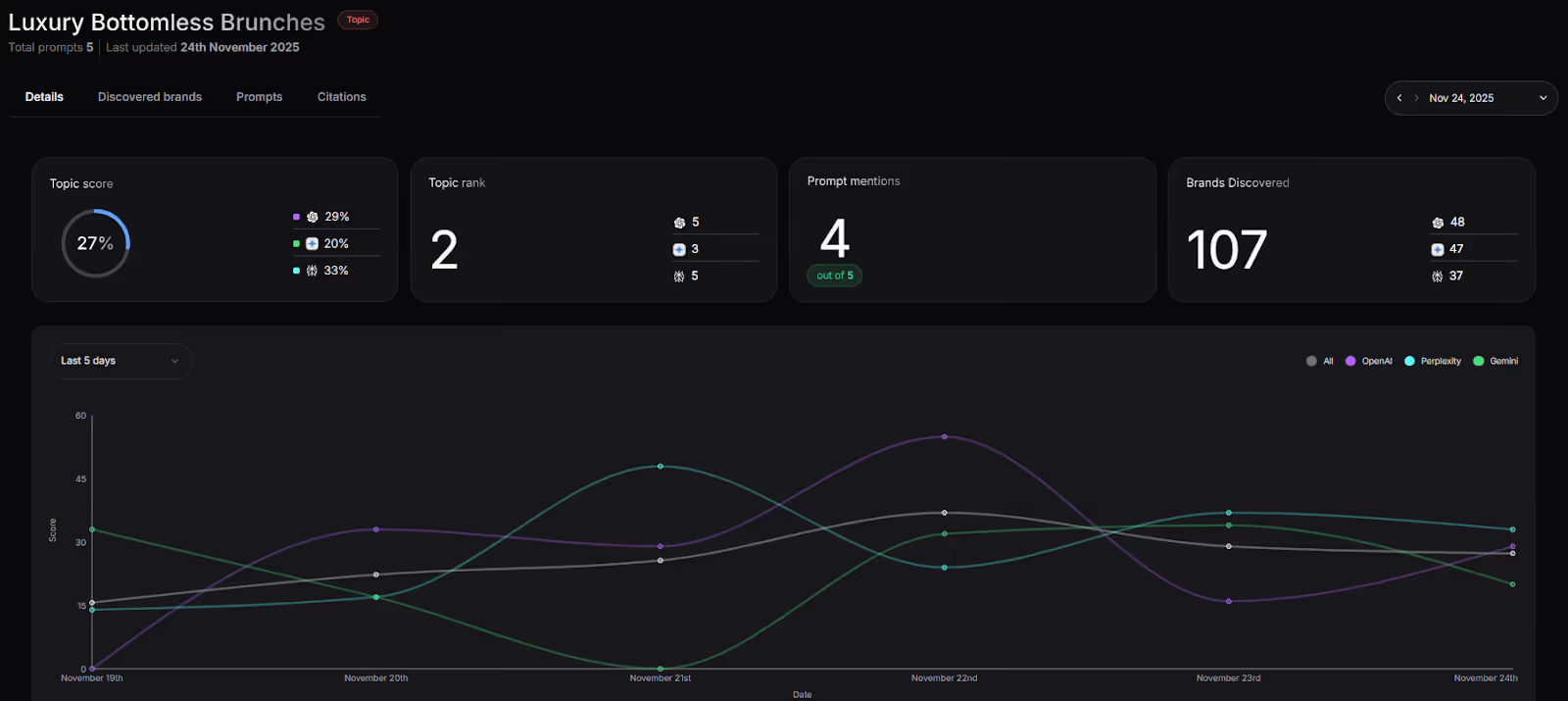
We analyzed 5 prompts under the topic ‘Luxury bottomless brunches’ for Atlantis The Palm, Dubai. And the topic cluster showed a score of 27%. This offers Atlantis a clear view of their brand’s performance against different query perceptions and not individual queries.
Citation Context Analysis
Not all mentions are created equal. BrandRadar shows you whether you're cited as a category leader, a budget alternative, or just mentioned in passing. This context helps you understand not just visibility, but positioning and even sentiment scores that help understand AI’s intelligent opinion of you.
Actionable Insights
Beyond data, BrandRadar provides specific recommendations: which prompts to prioritize, which content to optimize first, where your competitors are gaining ground, and what's working in your category.
Conclusion: The Window Is Now
Generative Engine Optimization isn't just the next trend in digital marketing. It's a fundamental shift in how brands are discovered, evaluated, and chosen by the customers who matter most to them.
As AI becomes the default way people ask questions, seek recommendations, and make decisions, being cited by LLMs like ChatGPT, Gemini, and Perplexity is no longer optional. It's strategic. It's competitive. And for many brands, it's becoming the difference between growth and irrelevance.
The good news? We're still in the early days of this shift.
See Your AI Visibility Today
Don't let competitors shape the narrative in your category while you're still figuring out the landscape.
👉 Book Your Personalized BrandRadar Demo Today
FAQs
How do I know if my brand shows up in AI answers?
You can track it! Tools like BrandRadar let you see which prompts mention your brand, how often, and on which AI engines. You’ll know if your competitors are being recommended instead of you, and where you might be missing opportunities.
Do I still need SEO?
Absolutely. GEO doesn’t replace SEO, it builds on it. SEO gets you found on search engines, GEO gets you recommended by AI. Both matter if you want to capture attention in the next wave of discovery.
What kind of content works best for GEO?
Clear, factual, and verifiable content wins. AI prefers things it can trust, think structured data, schema markup, expert insights, reviews, and stats. The more your content can be cited confidently, the better your AI visibility.
Which AI engines should I focus on?
It depends. ChatGPT tends to favor well-structured, sourced content. Gemini likes local and contextual details. Perplexity prioritizes editorial mentions and reviews. Ideally, you want to optimize across all three so your brand gets recommended wherever your audience asks.
Is Generative Engine Optimization real or hype?
It’s absolutely real, and hospitality brands are already seeing the impact.
- Travellers increasingly ask AI assistants instead of Googling.
- AI models “choose” which hotels to mention, often favouring credible, high-authority sources over branded marketing pages.
- Hotels that don’t optimize for GEO can become invisible in AI shortlists, even if their SEO is strong.

