Inside the UAE's AI Search Divide: How ChatGPT and Google AI Mode Reward Different Brands in Insurance and Automotive
September 9, 2026
There is a comforting story brands tell themselves about AI search: build good content, earn some authority, and the AI engines will find you and recommend you, more or less the same way Google used to. Our data says that story is only half true, and the other half depends entirely on which AI you are talking to.
We tested the same 50 prompts, two UAE brands, on both ChatGPT and Google AI Mode, and logged everything: who got mentioned, who got cited, and who got left out. The results show two fundamentally different systems for deciding who gets to be the answer, and most brands are currently only optimizing for one of them.
- Sample Size: 50 Selected and Relevant Prompts
- Topic Clusters: Direct Comparison | ‘Best Of’ | Local Intent | Problem Based | Long Tail
- Market: UAE
- Categories: Automotive | Motor Insurance
- AI Engines: ChatGPT | Google AI Mode
Why this Study?
The UAE is one of the most important markets in the world to get this right. The country recently became the first economy anywhere to cross 70% AI adoption among its working age population, according to Microsoft's AI Diffusion Report.
We picked two categories that matter commercially and behave very differently as content types: insurance and automotive. We earlier did a study on Sri Lanka’s Insurance Visibility, and the data taught us many things about consumer centric brands.
Methodology
We tested 25 prompts each for Sukoon Insurance, one of the UAE's most digitally active motor insurance brands, rebranded from its previous identity as Oman Insurance Company, and Toyota UAE, the long-standing market share leader in UAE new car sales, holding roughly 22-24% of the market according to recent industry sales data. Every prompt was run on both ChatGPT and Google AI Mode using BrandRadar's V2 platform in August 2026.
Prompts were split into 5 categories for each brand: best of and category questions, direct brand comparisons, problem or need based questions, local or location specific questions, and long tail category.
We are reporting this as a 2 category, 50 prompt snapshot for one market, captured at a single point in time. It is enough to see clear, repeatable patterns, but we would not extrapolate these exact percentages to every industry or every country without expanding the sample size. AI engine behaviour also changes as platforms update their retrieval methods and models, so these findings should be treated as a snapshot rather than a permanent benchmark.
Our Key Findings From This Study
- Google AI Mode consistently pulls more sources per answer than ChatGPT does.
For Sukoon, Google AI Mode's responses carried 475 total citations against ChatGPT's 337 across the same 25 prompts, roughly 41% more. For Toyota, the gap was 339 on Google AI Mode versus 281 on ChatGPT, about 21% more. This matches independent research on the two platforms.
A 2026 analysis of AI Mode's citation behavior found it typically attaches around 14 sources per answer, giving brands many more chances to appear somewhere in the response, while ChatGPT tends to name only a handful of sources per answer, which makes each one of those slots far more competitive.
- Brand owned content matters far more to ChatGPT than to Google AI Mode, and the size of that gap depends heavily on the category.
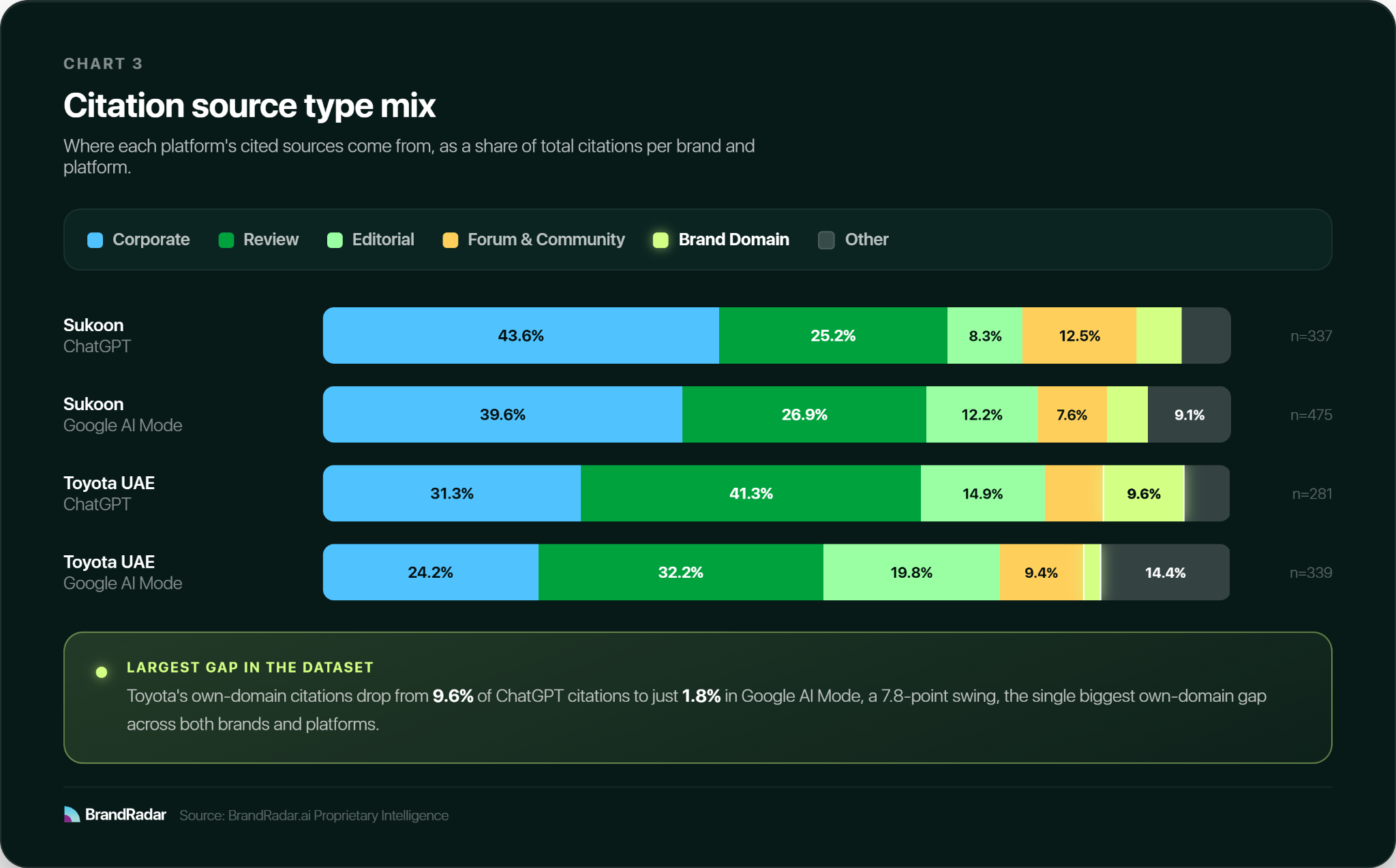
Toyota's own domain, toyota.ae, accounted for 9.6% of ChatGPT's citations but only 1.8% of Google AI Mode's citations for the exact same prompt set. Sukoon's own domain barely moved between platforms, sitting at 4.2% on ChatGPT and 4.4% on Google AI Mode. The difference is the category. Automotive brands with strong owned content and spec pages get rewarded more by ChatGPT. Insurance, a category where third party comparison sites dominate almost everywhere, sees far less benefit from brand owned pages on either platform.
Cross analysis: what actually explains the pattern
We wanted to further look across both brands, both platforms, and every topic category at once to tell you why this pattern emerges and what you can do about it.
1. Google AI Mode surfaces more brands per answer than ChatGPT, which makes it harder to hold a lead.
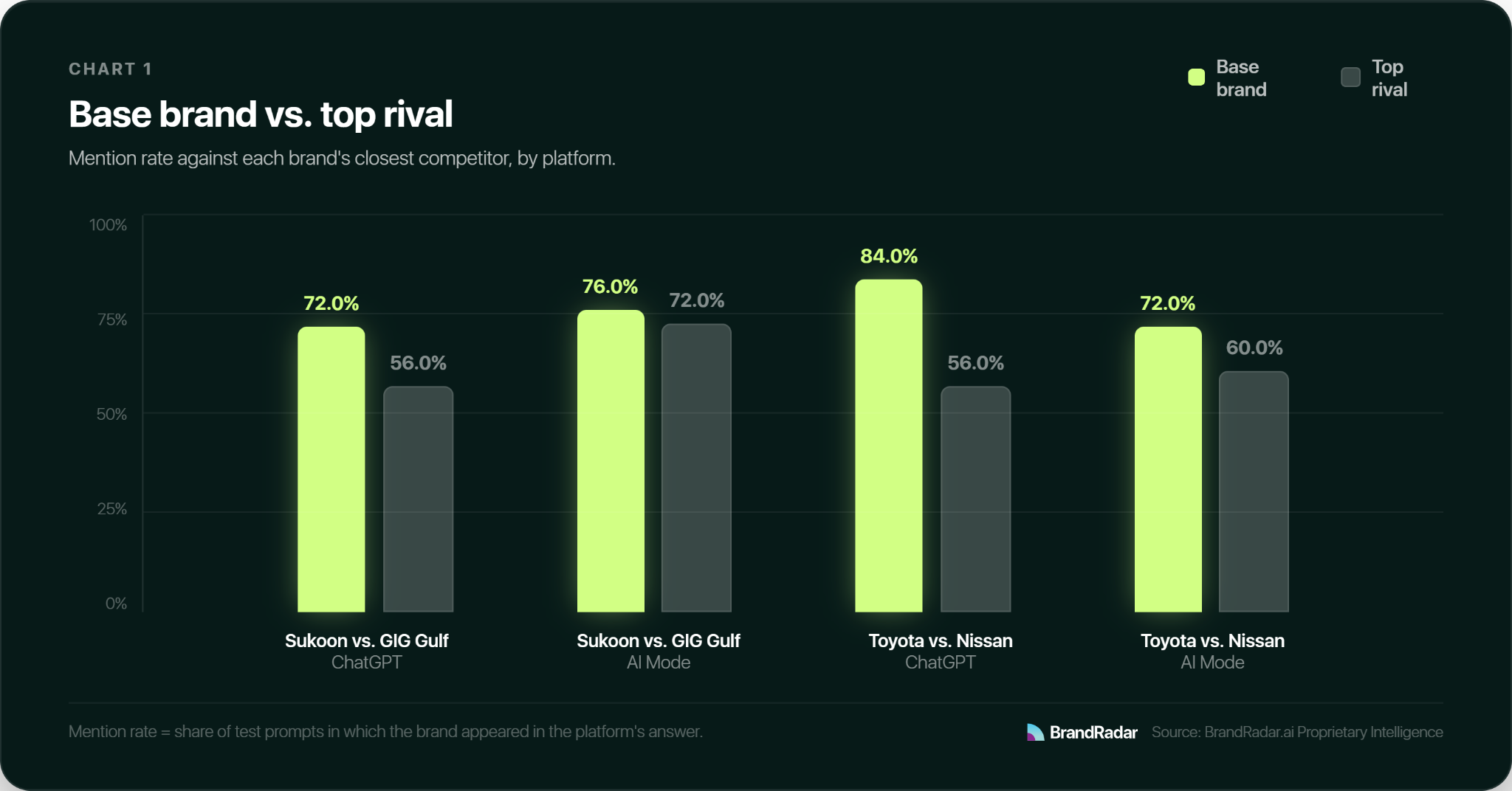
Because Google AI Mode casts a wider retrieval net, more competitors get a seat in the answer. The lead a brand holds over its closest rival shrinks sharply on Google AI Mode compared to ChatGPT:
- Sukoon's lead over GIG Gulf (one of the UAE's other major motor insurers): 16 percentage points on ChatGPT, down to just 4 points on Google AI Mode
- Toyota's lead over Nissan (its closest rival in UAE new car sales): 28 percentage points on ChatGPT, down to 12 points on Google AI Mode
If you are the stronger brand in your category, ChatGPT is where your lead is most visible. Google AI Mode is where it is most at risk of eroding.
2. More citations in a response does not mean your brand is more likely to be one of them.
Toyota's Google AI Mode responses carried more total citations than its ChatGPT responses, 339 on Google AI Mode versus 281 on ChatGPT, yet Toyota's mention rate was lower on Google AI Mode (72% vs 84% on ChatGPT). A platform that cites more sources per answer is giving more competitors a seat at the table. It is not automatically giving you a better one. Google AI Mode is in many ways a more competitive environment precisely because it is a more generous one.
3. The same topic type flips which platform wins depending on category, so there is no universal rule for which platform is "better" at a given intent.
Looking at Problem Based prompts specifically, we see a pattern. To shed light, these are two prompts we tested in this category: Which insurance company covers flood damage for cars in Dubai? And Best used car to buy in Dubai under 50,000 AED.
- Sukoon: 50% on ChatGPT, 66.7% on Google AI Mode → Google AI Mode wins
- Toyota: 83.3% on ChatGPT, 50% on Google AI Mode → ChatGPT wins
Identical prompt archetype, opposite platform winner depending on the brand's category. This rules out any generic claim that one platform is simply stronger for problem based or need driven queries.
What actually matters is whether your category's authority sites happen to sit inside the source pool each platform defaults to, and that is category specific, not platform specific.
4. Narrow queries reveal what AI thinks your brand is, and what it thinks you're not.
In the insurance category, AI's picture of Sukoon is largely borrowed from aggregators. Policybazaar and InsuranceMarket.ae dominate citation share across 18 to 21 of Sukoon's 25 prompts on both platforms. What those aggregators wrote about becomes what AI knows, and aggregators write about broad comparisons, not specific product strengths. That is why Sukoon scores 100% on "best motor insurance in the UAE" and drops to 25% on "does my policy cover roadside assistance." The brand is not missing from AI's awareness. It is missing from AI's knowledge of what it actually offers.
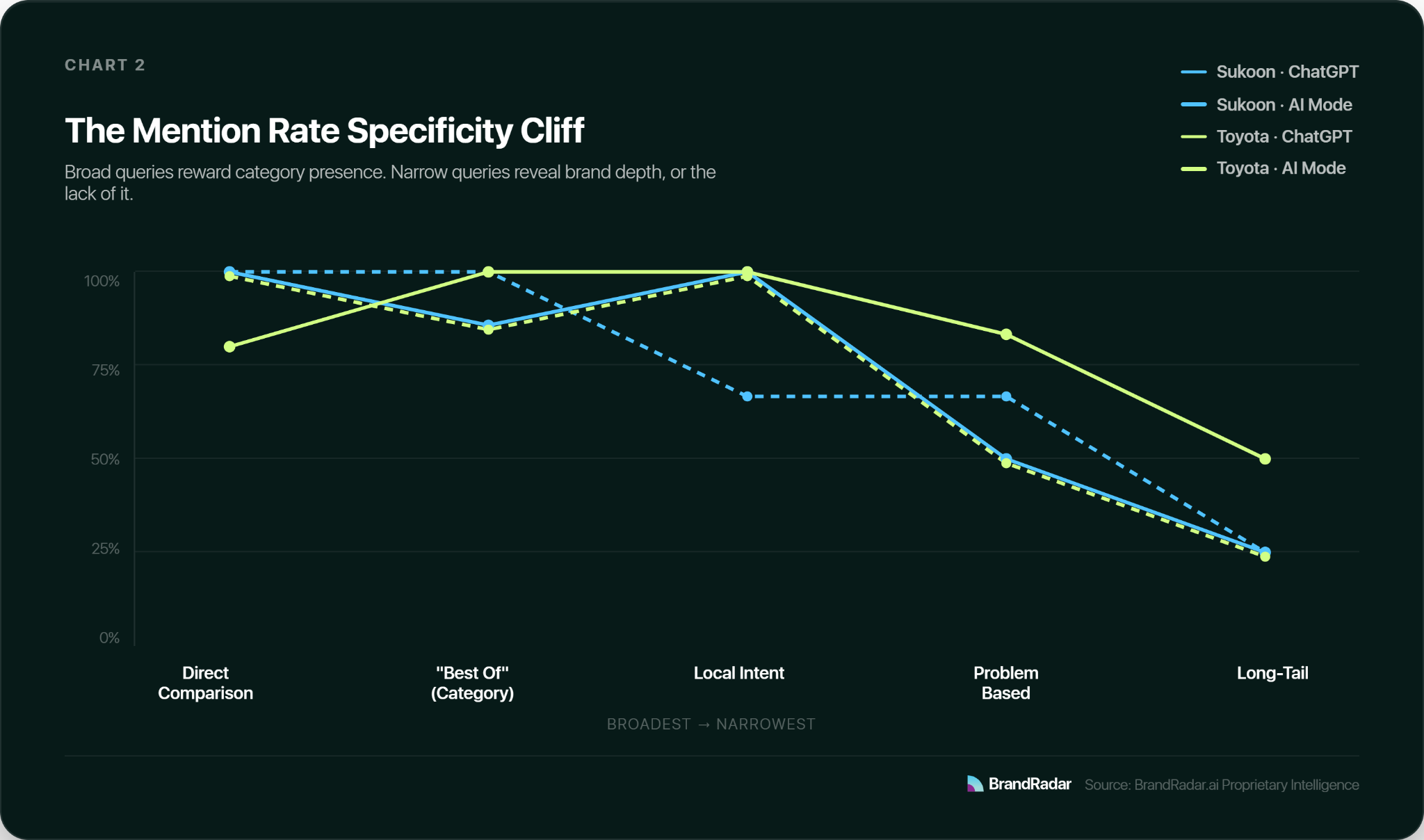
This pattern holds in automotive too. The downward slope in mention rate as queries get more specific is consistent across both brands and both platforms without exception, broad queries reward category presence, narrow queries reveal the limits of what AI has learned about you specifically.
The content that would actually fill this gap, specific, product-led, brand-owned answers to precise, long-tail customer questions, barely exists in either category today. That is the gap almost no competitor is filling, and it is the easiest one to move.
For a deeper look at how long-tail queries reshape AI visibility, read BrandRadar's white paper on long-tail keyword impact in hospitality AEO.
5. Owned domain content only moves the needle in categories without dominant aggregators in UAE’s Automotive and Insurance industry.
Toyota's own domain citation share swings from 9.6% to 1.8% between platforms, a wide range, and its mention rate swings with it. Sukoon's own domain share barely moves, 4.2% to 4.4%, and its mention rate is comparatively stable too.
This pattern is strongly supported within the two categories and the UAE market we tested, but it should not be read as a universal rule. What it does suggest is a clear strategic split: for automotive brands, owned content and YouTube presence are real visibility levers worth investing in, particularly for Google AI Mode. For insurance brands, the more effective path is earning mentions and coverage on the aggregator and comparison sites that already dominate the citation pool. Competing against them with brand owned pages is the wrong fight.
Insurance in detail: Sukoon Insurance
One of the UAE's most digitally invested insurers, Sukoon actually performs slightly better on Google AI Mode than on ChatGPT, yet its lead over GIG Gulf is the one that nearly vanishes on that same platform, dropping from 16 points to just 4
Sukoon's numbers confirm the aggregator problem directly.
- Policybazaar appeared in only 8 of Sukoon's 25 ChatGPT responses but 18 of 25 Google AI Mode responses.
- InsuranceMarket.ae showed a similar split, 9 on ChatGPT versus 17 on Google AI Mode.
Google AI Mode's wider retrieval net appears to reward exactly the kind of structured, comparison heavy content that aggregator sites publish at scale, which is also why Sukoon's competitive gap over GIG Gulf nearly disappears on that platform.
Sukoon's strongest results came from prompts that named the brand directly alongside a specific rival, hitting 100% mention on both platforms. That confirms there is no entity recognition problem with the brand itself.
Automotive in detail: Toyota UAE
Toyota holds roughly 22-24% of UAE new car sales according to recent industry data, a significantly larger share than Nissan, its closest tracked rival. Ask ChatGPT about the best car brand in the country and it agrees, naming Toyota in 84% of our test prompts. Ask Google AI Mode the exact same questions, on the exact same day, and that lead nearly disappears, Toyota's advantage over Nissan shrinks from 28 points to just 12.
- On ChatGPT, its top cited domains were toyota.ae, uae.autotraders.ae, consumerreports.org, and reddit.com, a mix leaning toward brand content plus review and classifieds sites.
- On Google AI Mode, the top sources were reddit.com, youtube.com, yallamotor.com, and arabwheels.ae, leaning almost entirely toward third party video and community content.
Toyota's YouTube citation count was 23 on Google AI Mode against just 1 on ChatGPT, one of the largest single source gaps anywhere in the dataset. This is a meaningful signal for automotive brands: video content is a genuine citation source on Google AI Mode in ways it simply is not on ChatGPT. Brands that have invested in YouTube presence are being rewarded for it specifically on Google AI Mode, and brands that haven't are leaving a real visibility lever unused.
Nissan appeared in 14 of Toyota's 25 ChatGPT prompts and 15 of 25 Google AI Mode prompts, despite Toyota's considerably larger market share. Real world sales leadership does not automatically carry over into AI answer visibility.
Citation sourcing techniques on each platform
During our study, we came across a particularly interesting citation source mix, and decided to look further into the sourcing techniques of where each engine pulls its answers from.
How ChatGPT selects and structures citations
A Search Engine Land study of 8,000 AI citations found ChatGPT leans toward high authority, factual sources such as Wikipedia, established news outlets, and expert focused sites more heavily than Google's AI surfaces do, which matches the heavier Corporate and Review skew we saw in both brands' ChatGPT citation mix.
ChatGPT also does not search the live web on every query. Independent clickstream analysis from Semrush puts its web search activation rate at roughly 34.5% of queries, meaning a majority of answers may draw on training data rather than a live crawl. That raises the value of consistent, well established brand mentions across the web well before someone asks the question, since there may be no live retrieval step to correct an outdated picture.
How Google AI Mode selects and structures citations
Google AI Mode uses what Google calls a query fan out technique, issuing multiple related searches across subtopics before synthesizing a single answer, and it attaches far more sources per response than ChatGPT does, commonly cited at around 14 per answer in recent analysis.
That is consistent with what we measured directly: 20-40% more total citations on Google AI Mode than on ChatGPT for the identical prompt set, on both brands.
One finding worth calling out specifically: Sukoon's Google AI Mode responses cited google.com, effectively links back to Google's own search results pages, 66 times across 25 prompts, making it the single most cited domain by a wide margin. This suggests Google AI Mode is not always replacing traditional search so much as routing users back into it. For brands, this means that organic search visibility and AI Mode visibility are more connected than they might appear, a strong traditional search presence can still feed into AI Mode citation share.
The shared foundation
Despite the architectural differences, both platforms reward the same underlying signals at the brand level: consistent mentions of your brand name in context across third party sites that each platform already trusts.
Ahrefs research analyzing 75,000 brands found domain authority and backlink count only weakly correlated with AI Overview inclusion, while branded web mentions had the strongest correlation of any signal tested. The platforms retrieve differently. What they are looking for is more similar than it appears.
Frequently asked questions
Should I optimize for ChatGPT or Google AI Mode first?
It depends on your category more than your brand, and specifically on whether your category is mediated by aggregator or comparison sites. In our UAE data, the insurance brand performed slightly better on Google AI Mode, where aggregators get amplified, while the automotive brand performed clearly better on ChatGPT. There is no universal answer across topic types either, since the same prompt archetype favored different platforms depending on the brand's category.
Do ChatGPT and Google AI Mode cite the same sources?
Only partially. In our data, the two platforms cited noticeably different top domains for the same brand and the same prompts. ChatGPT leaned more toward corporate and review sources, while Google AI Mode leaned more toward video, forum, and its own properties. Independent research on this question has found similarly low overlap between the two platforms' top cited domains.
Is a Wikipedia page or brand owned content more important for AI visibility?
It depends on the platform and category. Brand owned domain content made up nearly 10% of ChatGPT's citations for the automotive brand in our UAE study but under 2% of Google AI Mode's citations for the same brand and prompts. In the aggregator dominated insurance category, owned content stayed flat around 4-5% on both platforms and was never the primary lever either way.
Does market share predict AI visibility?
Not reliably. Toyota holds significantly larger UAE new car market share than Nissan, but Nissan appeared in nearly the same number of AI responses across both platforms. Real world market leadership does not automatically translate into AI answer visibility.
Why does my brand disappear on the most specific questions even though I lead the category?
Because AI's opinion of your brand has limits. Both brands in our study scored 80-100% on broad category and comparison questions, then dropped to 25-50% on the narrowest, most specific questions, on both platforms. This is not a brand strength problem, it is a content coverage gap. AI knows you exist in the category. It does not know enough about your specific product strengths to cite you when questions get precise. That gap is usually the easiest one to fix, since so little competing content exists at that level of specificity.
Conclusion
Brand visibility in AI search is not one score across one platform. Sukoon and Toyota each led on a different engine, and both lost ground to rivals specifically on Google AI Mode. The clearest pattern was not about brand strength, it was about where AI has formed a clear opinion of your brand and where it has not. Narrow, specific questions are where that boundary becomes visible, and they are also where almost no competing content currently exists.
Sign up with BrandRadar, get access to the V2 platform, and start optimizing your brand for ChatGPT, Gemini, Google AI Mode and Claude.

