AI SEO Explained: How Prompts, Citations, and Visibility Shape Modern Discovery
February 9, 2026
.avif)

Afrah Fazlulhaq
Key Takeaways
- AI SEO extends traditional SEO into AI-driven discovery. It focuses on how generative systems interpret existing SEO signals to surface brands inside AI answers, without replacing SEO fundamentals.
- Intent-rich prompts shape outcomes. Rankings still matter, but small shifts in phrasing and context can significantly change which brands AI systems surface and recommend.
- Citations, sentiment, and Share of Voice are core AI SEO and GEO signals. Together, they influence trust, consistency, and how often, and how positively, brands appear in AI-generated responses.
- AI supports execution, but AI SEO strategy remains human-led. Tools assist with analysis and pattern recognition, but influencing recommendations requires deliberate positioning and signal management.
- Brands that align ranking signals with AI interpretation and recommendation signals are best positioned to drive consideration, demand, and growth.
If your marketing strategy still treats AI Discovery as purely about keywords, backlinks, and manual procedures, you’re missing half the picture. AI search isn’t replacing Google; it’s reshaping how visibility happens, across systems. To succeed in this new environment, you need a shared language and a clear framework.
Below is a comprehensive guide by BrandRadar, for marketers and brand owners on AI SEO, explained in simple, practical language, plus guidance on how to learn and implement AI SEO, GEO, essential skills, and the best tools.
What Is AI SEO (and How Is It Different From Traditional SEO?)
Traditional SEO focuses on helping pages rank in search results, using signals like keywords, links, content quality, and technical structure.
AI SEO builds on those same foundations, and expands the focus toward how generative systems interpret intent, evaluate signals, and decide which brands to surface inside answers.
Instead of competing only for positions on a results page, brands now also compete for inclusion in AI-generated responses, where context, phrasing, and interpretation play a much larger role.
An analysis of nearly 2 million LLM-driven discovery sessions found that AI platforms are now a meaningful layer in how people research and choose brands, with ChatGPT alone accounting for over 84% of tracked AI discovery activity .
As a result, visibility becomes less deterministic. The same brand may appear or disappear depending on how a question is framed, what intent is inferred, and how consistently the brand is recognized across prompts, citations, and sentiment signals.
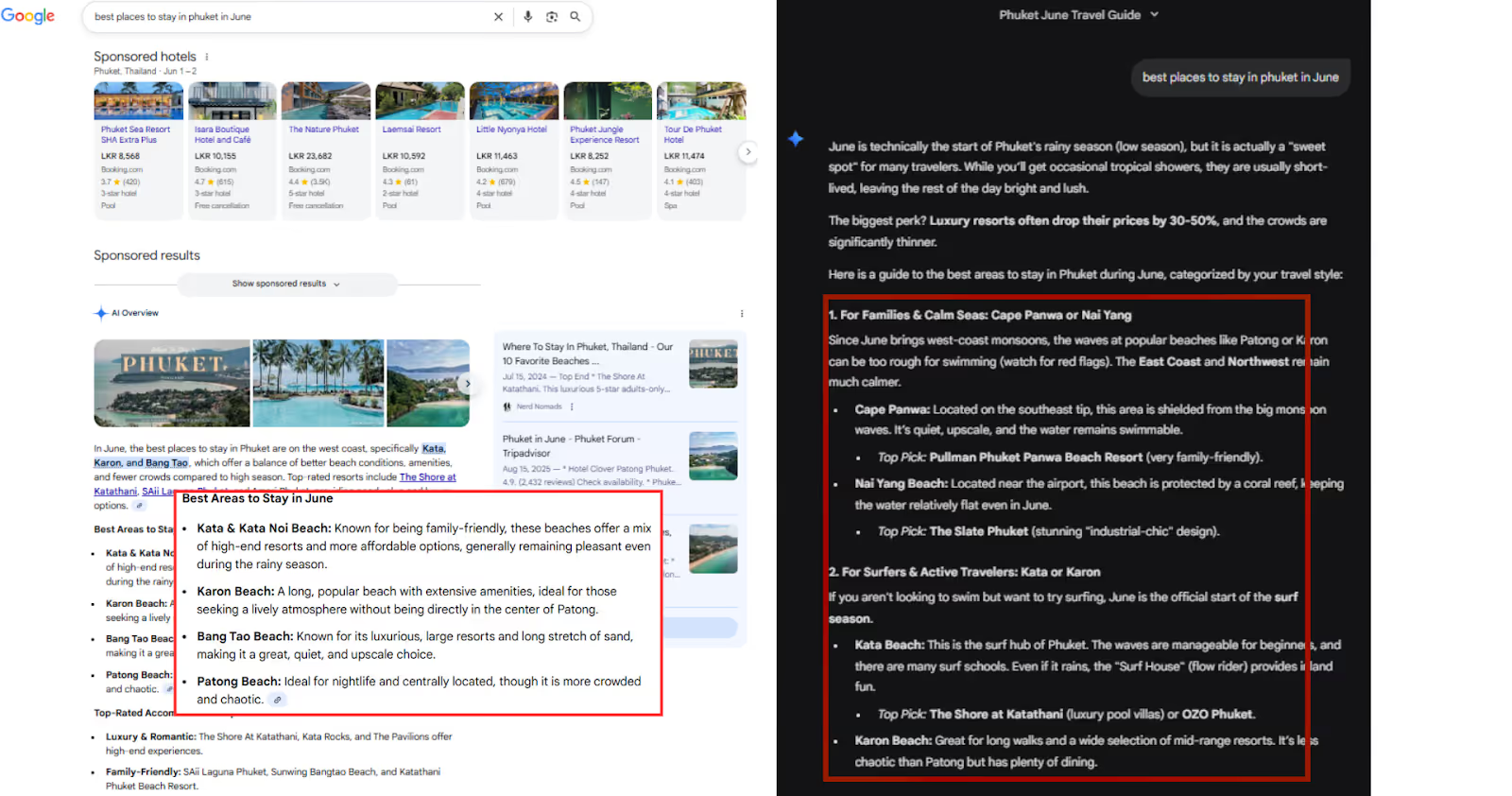
This can be seen clearly within Google’s own ecosystem. Traditional Search, Gemini, and AI Overviews rely on many of the same underlying signals, yet they surface different answers, and brand recommendations depending on how those signals are interpreted in each context. Consistency cannot be assumed, even within the same platform.
AI SEO Vs GEO
AI SEO and GEO are often used interchangeably, but there’s confusion between the terms. Certain definitions brought up by tools like SEMrush say that AI SEO is the automation of manual SEO, while the majority understands it as GEO or both automating SEO and GEO, enabling modern discovery.
What Is SEO for AI?
SEO solely for AI is known as Answer Engine Optimization (AEO) or more commonly as Generative Engine Optimization (GEO). With AI search rapidly growing, people are curious whether this will be a new discipline of its own. While fundamental theories of GEO Vs. SEO are similar, there are distinct differences.
Key AI SEO Terms For Visibility Explained
There are many AI SEO terms that marketers and brands will eventually have to make familiar with, and these are the most important metrics to measure AI visibility.
Prompt
A prompt is simply the question or instruction given to an AI system. Think of it as the evolution of a keyword. The difference between prompts and keywords is its custom nature. When you enter a prompt, the responses that AI provides is personalized for you.
Instead of typing “best hotels Singapore”, (how Google will cater to a query), a user might ask “Which boutique hotels in Singapore are best for couples seeking a weekend stay?” and AI will cater with a custom answer.
This added detail, intent and modifiers, makes it a long-tail prompt. Long-tail prompts are far closer to natural language and reflect real user intent, which is precisely what AI systems evaluate.
BrandRadar’s 2026 study examined 200+ hospitality long-tail prompts across Dubai, Singapore, Mumbai, and Sri Lanka, revealing that small intent modifiers like adjectives can shift AI brand recommendations by an average of 42%.
Why prompts matter
- AI systems generate answers based on how well data matches what the user asked.
- Small word choices (like family-friendly, luxury, budget) dramatically change which brands are surfaced.
- The same content can perform very differently depending on prompt phrasing.
Citations
In AI contexts, a citation isn’t just a backlink. It’s when the AI references a brand, site, entity, or source within an answer, either explicitly or implicitly.
For example, an AI answer like: “According to Tripadvisor and recent traveler reviews, Marina Bay Sands is among the top luxury hotel stays in Singapore…” contains citations to authoritative sources.
Why citations matter
- They signal trust and authority to the AI system.
- More consistent citations across high-intent prompts often correlate with higher visibility.
- Citations can originate from structured data, trustworthy content, user-generated content, and business mentions.
Unlike backlinks (which influence ranking in classic SERPs), AI citations influence recommendation logic, they help the model “recognize” which brands matter for a given query.
Sentiment
Sentiment refers to the emotional or evaluative tone associated with mentions of a brand in AI answers. Due to AI’s conversational nature, emotions are often portrayed as trust signals. You’d already know how AI responds when you ask specific questions related to a brand. AI systems don’t just list options, they often frame them.
For example:
- Positive: “Widely praised for exceptional service…”
- Neutral: “Offers standard amenities…”
- Negative: “Often criticized for outdated rooms…”
Why sentiment matters
- If a brand mostly appears in negative contexts, AI may be less likely to recommend it for intent-driven prompts (e.g., best for families).
- Sentiment affects perception and trust, even when the brand does appear.
- Tracking sentiment helps you understand whether you’re being seen positively, negatively, or merely neutrally.
Sentiment analysis in AI answers is similar to brand perception analysis in traditional marketing, but it directly influences discoverability inside generative answers.
Share-of-Voice / Brand Visibility Score (BV)
Share-of-Voice (SOV) or Brand Visibility Score traditionally describes how much visibility a brand gets in search or advertising compared to competitors. In AI SEO, Share-of-Voice refers to how often a brand appears across relevant AI prompts and contexts. Similar to how ranking works in Google, but instead of being listed on pages, the visibility score calculates how likely you are to appear in answers when people enter prompts.
A brand that surfaces consistently across multiple prompts (e.g., best Thai restaurants in Bangkok, top value hotels, eco-friendly stays) has higher AI SOV.
Why AI Share-of-Voice matters
- It shows consistency of visibility, not just one-off mentions.
- Brands with high SOV are more likely to be treated as default answers by AI.
- SOV is a proxy for authority in AI discovery, similar to how domain authority functions in classic SEO.
While traditional SOV is measured in rankings or impressions, AI SOV is measured in appearance frequency, context relevance, and model confidence across prompts.
How These AI SEO Metrics Work Together
Understanding terms in isolation is valuable, but real insight comes when you see how they interact. BrandRadar.ai optimization for modern discovery works this way;
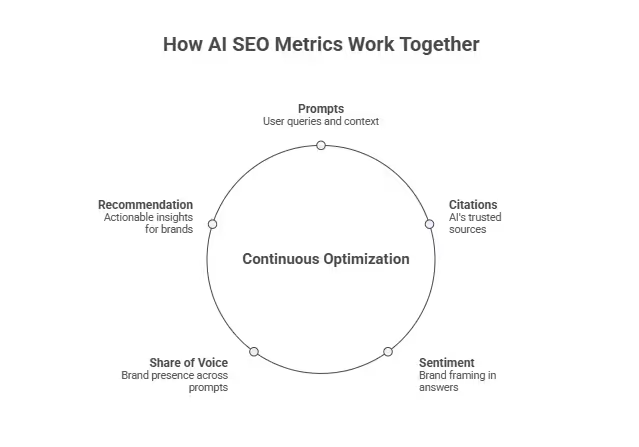
When combined, these signals determine whether a brand is surfaced consistently, framed positively or negatively or ignored entirely. BrandRadar provides all this data including analytics on competitor performance, whether you’re outranked by competitors inside AI answers.
Crucially, these AI SEO signals operate alongside traditional SEO metrics like backlinks, keyword ranks, and click-through rates. A robust visibility strategy must consider both.
AI SEO Glossary
Zero-Click Result
A zero-click result occurs when a user gets the answer they need directly on the search or AI interface, without clicking through to a website. AI Overviews, featured snippets, and direct answers all contribute to zero-click behavior, making visibility inside answers as important as traffic itself.
E-E-A-T (Experience, Expertise, Authoritativeness, Trustworthiness)
E-E-A-T is Google’s framework for evaluating content quality and credibility. It helps determine which sources are trusted enough to rank, be cited, or be referenced in AI-generated answers, especially for high-impact or decision-driven queries.
Non-Determinism
Non-determinism refers to the fact that AI systems may produce different answers to the same question at different times. Because AI responses depend on context, phrasing, and probabilistic models, brand visibility in AI answers is not fixed or guaranteed.
Entity Recognition
Entity recognition is how AI systems identify and understand specific entities such as brands, locations, people, or products. Strong entity recognition helps AI models correctly associate a brand with relevant topics and include it in appropriate answers.
Fan-Out Queries
Fan-out queries occur when an AI system breaks a single question into multiple sub-questions behind the scenes to generate a complete answer. These internal queries pull information from different sources, increasing competition for visibility across multiple angles of intent.
SSR (Server-Side Rendering)
Server-side rendering (SSR) is a method where web pages are rendered on the server before being delivered to the user. SSR improves crawlability and performance, making content easier for search engines and AI systems to process and understand.
Chunking
Chunking is the process of breaking content into smaller, structured sections that AI systems can easily interpret and retrieve. Well-chunked content increases the likelihood of being cited or summarized accurately in AI answers.
AI Snippet
An AI snippet is a summarized response generated by an AI system that directly answers a user’s question. Unlike traditional snippets, AI snippets are synthesized from multiple sources and reflect how AI models interpret relevance, trust, and context.
Can SEO Be Done by AI?
Not entirely. But most manual tasks can be automated, which is sometimes called AI SEO, but AI SEO in this definition can’t fully replace human strategy.
AI tools can generate keyword ideas, suggest content structure, analyze competitor signals, and predict user intent patterns. but it cannot find actual data related to your brand’s visibility, the keywords you absolutely need to rank for, and simply analytics.
What’s more? AI cannot make strategic decisions about brand positioning, evaluate business goals and prioritize what matters, determine holistic visibility outcomes across multiple channels.
How To Learn AI SEO In 2 Steps
If you’re wondering “How do I learn AI SEO?”, you’re not alone. The field is emerging fast, but the learning path is grounded in strong fundamentals. Understanding modern discovery, here’s how to learn AI SEO in 2 steps:
Step 1: Foundational SEO, Enhanced With AI Workflows
- Keyword research: AI-assisted workflows analyze large query sets to identify emerging demand patterns, intent clusters, and long-tail opportunities that traditional tools often miss, helping teams prioritize where visibility actually matters.
- Content strategy: AI workflows map real user questions to content gaps, ensuring pages are built to answer intent end-to-end, not just target isolated keywords. This improves relevance for both search engines and AI-generated answers.
- Technical SEO: Automated audits and structured data workflows help maintain clean architecture, consistent indexing, and machine-readable signals, making content easier for both crawlers and AI systems to interpret accurately.
- Analytics and measurement: AI-powered analysis connects rankings, visibility signals, and engagement patterns to reveal performance beyond traffic alone, highlighting where content influences discovery even without clicks.
Step 2: Familiarize with Generative AI Terms and Algorithms.
- Understand generative AI systems: Learn how platforms like ChatGPT, Gemini, and Perplexity generate answers.
- Learn how AI interprets language and intent: AI models analyze meaning, relationships between concepts, and contextual cues to decide which brands are most relevant for a specific question.
- Practice prompt design and optimization: Prompts shape AI answers. Experimenting with different wording, constraints, and intent modifiers helps you understand how small changes influence which brands appear and how they’re framed.
- Study entity recognition and semantic search: AI systems rely heavily on entities, brands, locations, products, and concepts, and how they connect. Strong, consistent entity signals across content improve recognition and recommendation.
Together, these AI-specific skills allow marketers to move from ranking pages to influencing answers, the core shift behind modern AI SEO.
What Skills Are Needed for AI SEO?
AI SEO combines familiar SEO expertise with new skills focused on how AI systems process language, entities, and intent.
At BrandRadar we offer managed GEO services to help you achieve success on AI platforms without having to hire an entire team. But if you’re a marketer who’d like to polish up your skills in AI SEO, here’s what you need to have:
- Visibility workflow management: managing how SEO, content, and brand signals align across AI and search surfaces
- Prompt literacy: knowing how to phrase and adjust queries to shape AI behavior
- Semantic understanding: recognizing how meaning and context influence AI responses
- Data analysis: interpreting visibility patterns across platforms
- Content strategy: organizing content that answers real user questions
- Competitive analysis: seeing not just where you rank, but where others are recommended
- Measurement mindset: defining metrics that reflect visibility not just traffic
AI SEO is as much about understanding intent and language as it is about technical execution.
The Best AI SEO Tools
As AI systems increasingly influence how brands are surfaced and recommended, two distinct categories of tools have emerged. Generative Engine Optimization (GEO) tools are built specifically to measure and manage visibility inside AI-generated answers, and hybrid, SEO tools that offer traditional SEO capabilities, workflows and AI-assisted features.
Together, these tools support modern discovery, but they serve different roles. Below are some of the leading platforms shaping AI-influenced search and brand discovery today.
1. BrandRadar.ai - Full Discovery Intelligence, Recommendations and Content
BrandRadar is a dedicated AI visibility intelligence platform that tracks how brands appear across generative AI responses and search ecosystems. It analyzes prompt-level visibility, sentiment, citations, and Share of Voice, helping teams understand why and where brands show up. Additionally, it provides recommendations and cross-platform content generation capabilities.
BrandRadar also offers a managed service, making it ideal for teams that want expert support alongside powerful analytics without having to piece GEO workflows together themselves.
2. Ahrefs - Comprehensive SEO & Research Suite
Ahrefs remains a cornerstone for traditional SEO research, providing industry-leading backlink data, keyword research, competitor analysis, and ranking tracking. While not AI-native, its robust datasets feed into AI SEO workflows by uncovering demand patterns and competitive gaps that inform discovery optimization.
3. SEMrush - All-In-One Marketing Intelligence
SEMrush offers keyword and competitor insights, site audits, and trend tracking that support modern search strategies. Its keyword intent data and SERP features reports help teams align content with both traditional search and AI query patterns, making it a useful hybrid tool in AI SEO stacks.
While it provides analytics, as a non-AI native platform, it doesn’t help brands with strategy formations.
4. Frase - AI-Enhanced Content Optimization
Frase uses AI to generate content briefs and optimize content around real user questions and topics. By analyzing SERPs and suggested content themes, Frase helps teams craft pages that are more likely to satisfy both search engines and AI answer systems.
5. Surfer SEO - Data-Driven Content Relevance
Surfer SEO combines SERP analysis with topical relevance scoring to inform content structure and keyword usage. It helps teams build content that closely aligns with query intent, improving performance in both search results and answer-driven discovery contexts.
6. Clearscope - Semantic Content Optimization
Clearscope uses natural language processing to identify key terms and concepts that top-performing content covers. This aids teams in building more comprehensive, semantically rich content, a key factor for content that AI systems trust and reference in answers.
7. MarketMuse - AI-Driven Content Strategy
MarketMuse applies AI to uncover content gaps, prioritize topic clusters, and plan strategic content coverage. Its competitive insights and topic models help teams expand authority across thematic areas that matter for both SEO and AI-driven visibility.
8. Jasper - AI Content Creation
Jasper specializes in AI-assisted content generation, helping teams accelerate writing while staying aligned with intent and relevance. While primarily focused on drafting content, Jasper can support prompt experimentation and content ideation within AI SEO workflows.
How to Build a Winning AI SEO Stack
No single tool solves every need. The most effective modern discovery workflows typically combine:
- An advanced GEO-native platform (like BrandRadar) for visibility measurement, prompt analysis, interpretation, recommendation and GEO content optimization.
- SEO research platforms (Ahrefs / SEMrush) to understand demand and competitive gaps.
- SEO Content optimization tools (Frase, Surfer, Clearscope) to improve relevancy and topical coverage.
Or, you can skip all the steps entirely and;
- Sign up with BrandRadar’s Modern Discovery Agency to get your brand found across AI and Google.
Why Traditional SEO Metrics Aren’t Enough Anymore
You might still rank well on Google but never show up in AI answers for key discovery prompts. That’s because traditional ranking doesn’t guarantee answer recommendations, clicks and impressions don’t equate to visibility inside AI systems, and AI models surface answers, not just links
If your analytics show traffic growth but your brand is invisible in AI-driven recommendations, your visibility strategy is incomplete.
The future of discovery requires both, ranking signals and answer signals working together.
12. Frequently Asked Questions (FAQs)
Q1: Is SEO still relevant with AI?
Yes, SEO is still essential, but it must adapt. Ranking content on search engines still drives discovery, but AI systems now influence what is recommended inside answers.
Q2: Can brands control how they appear in AI answers?
Brands can influence AI visibility by optimizing content for real user questions, structured data, citations, and consistent signals across contexts.
Q3: Do backlinks still matter in AI search?
Backlinks still matter for traditional ranking. For AI SEO, they can contribute to authority signals, but AI visibility also depends on other signals like citations and context relevance.
Q4: How do I know if my brand appears in AI answers?
You need tools like BrandRadar that analyze visibility across prompt variations and model outputs, traditional analytics alone won’t show this.
Q5: Is AI SEO only relevant for large brands?
No, it benefits any brand that wants to increase visibility in AI-influenced discovery, including SMBs and niche industries.
Conclusion
Search is now about meaning, context, and relevance, and AI systems are now a major part of how people find answers, not just pages.
Understanding AI SEO terminology like prompts, citations, sentiment, and Share of Voice, is practical. It gives brands a language of visibility that can guide strategy, investment, and execution.
If you’re ready to compete in modern discovery, you need AI SEO. Learn how this works in reality. Book a free call.

